

Science Highlight: Wireless Edge Technology Enables Near-Real-Time Geothermal Data Transmission
ESnet Communications, media@es.net
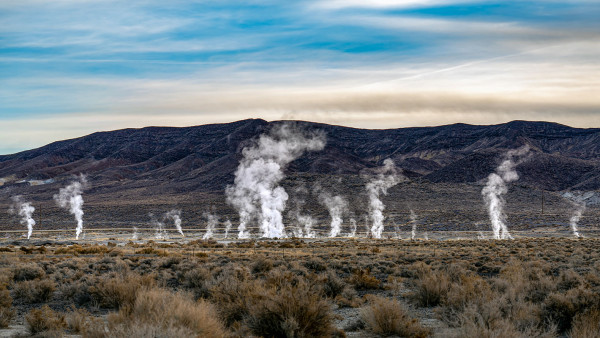
Steam rising from geothermal vents in the Nevada desert
The Science
Geothermal energy, heat mined from deep inside the Earth, is a plentiful, renewable, and reliable way to generate electricity. Geophysicists in Berkeley Lab’s Energy Geosciences Division are developing new ways to map geological features hidden under kilometers of rocks and sediments as well as deploying diverse geophysical methods and monitoring systems in order to increase production of geothermal energy while minimizing the risk for seismicity. Ormat Technologies Inc. is an international geothermal company selling geothermal technology and operating geothermal power plants around the world. The Berkeley Lab researchers have deployed a network of eight sensors at Ormat’s Jersey Valley facility in north-central Nevada. These sensors collect data on ground motion to monitor for seismicity at the site in anticipation of planned fluid-injection activities for geothermal energy production.
The Impact
The area in which the Berkeley Lab teams’ sensors are deployed is remote, accessible only via a dirt road, and does not have uniform reliable cell coverage for transmitting the data from those sensors. ESnet’s Wireless Edge team figured out an economical, effective plan for placing wireless networking equipment around the site, including at a few locations isolated by a narrow canyon, which has made it possible for the researchers to connect to their sensors and gather data in near real time from the site. This connectivity allows plant operators to monitor seismic activity and, if needed, regulate their subsurface injection and extraction processes as they are happening. The seismic events also allow the operators to better understand the reservoir that supplies the geothermal fluids.
Additional Details
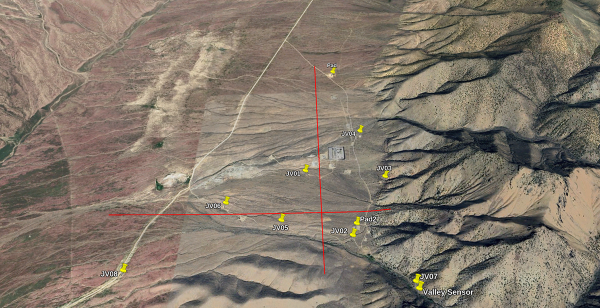
Topological map showing the Ormat site’s sensor placement and possible wireless coverage
ESnet staff made several visits to the site and deployed the Greenfield Wireless mobile private cellular tower, a portable, self-powered tower that integrates multiple wireless technologies, including private cellular 4G (Citizens Broadband Radio Service, or CBRS); Wi-Fi HaLow for long-range, low-bandwidth connections; standard Wi-Fi; satellite broadband (via Starlink); and directional radio links. To assess connectivity needs, the team uses a mobile test unit that rapidly generates multi-technology wireless coverage maps. This approach allows quick and precise identification of the best wireless solution for each unique field site. Working with the researchers to overcome challenging limitations on solar power in the canyon, the ESnet team set up a combination of multi-hop directional wireless links for long-range networking and Starlink equipment for backhaul connectivity that allows the sensors to transmit their data reliably and continuously to Berkeley Lab for real-time analysis.
ESnet Contact: Andrew Wiedlea, engage@es.net
Collaborating Institutions: Berkeley Lab

