

ESnet Codesign Efforts Honored with Director’s Award for GRETA Project
By Bonnie Powell, media@es.net
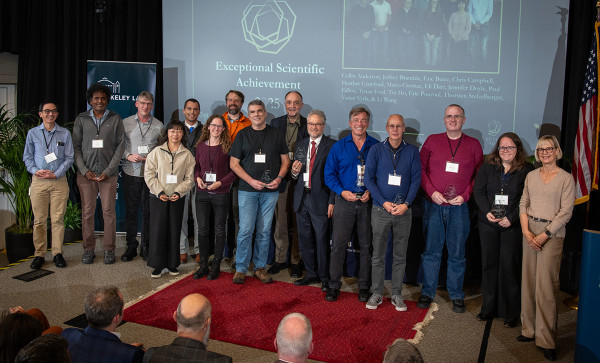
ESnet’s Eric Pouyoul and Eli Dart (center, in black shirt and suit, respectively) with other Berkeley Lab members of the GRETA project team
ESnet Advanced Technologies & Testbeds Engineer Eric Pouyoul and Science Engagement Engineer Eli Dart were among the Gamma-Ray Energy Tracking Array (GRETA) project team members honored on Nov. 12 with a 2025 Director’s Award for Exceptional Achievement from Berkeley Lab. The team was recognized for “delivering the project scope for GRETA, a next-generation microscope into the quantum world of atomic nuclei at the Facility for Rare Isotope Beams, on time and on budget with fully demonstrated performance.” After seven years of development, the detector and its computing pipeline have passed all milestones with flying colors, and GRETA is currently being installed at FRIB, where it will yield insights into the fundamental building blocks of our world and the forces that make matter exist.
GRETA has been a shining illustration of ESnet’s co-design approach, in which ESnet staff collaborate with domain scientists and project teams to leverage or develop innovative new network capabilities that will accelerate their scientific research. (In addition to FRIB and Berkeley Lab, staff from Argonne and Oak Ridge National Laboratories are part of GRETA.)
Working closely with Staff Scientist Mario Cromaz and others in Berkeley Lab’s Nuclear Science Division, Dart served as the System Architect for the computing area of the GRETA project, overseeing network design, security architecture/design, and related contributions. Pouyoul designed and implemented the high-performance streaming software for the GRETA computing pipeline.
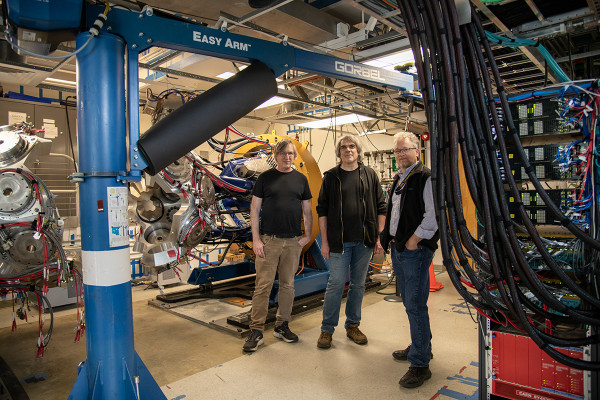
GRETA team members Mario Cromaz (Nuclear Sciences), Pouyoul, and Dart with the detector as it neared completion; the aqua fiber cables at far right are the source of data for the software pipeline.
The GRETA software can receive 32 gigabits of data per second from the detector electronics and distribute it to the online data analysis cluster for prompt signal processing — all on commodity server hardware using standard Linux containers. Pouyoul also implemented the event builder, which receives the output of the signal processing cluster, orders everything according to the global hardware clock timestamp in the data, sends a portion of the feed off to visualization, and passes the ordered event stream to the storage service, which he also implemented. In addition, he built a detector simulator, which sent either synthetic or previously captured scientific data into the pipeline with realistic behavior to test the system before the electronics were finished. (Learn more about how access to High Performance Computing was integrated into GRETA’s design, and how it inspired the Berkeley Lab-funded DELERIA project. which can stream data from other detectors to HPC.)
The new software pipeline “lets us take advantage of the extensive and significant computational advantage at the remote facilities,” said Heather Crawford, Nuclear Science Division senior staff scientist and GRETA Deputy Project Director. “Now we get to think about, ‘How can we do this even better?’”
While Pouyoul and Dart led ESnet’s efforts, other ESnet engineers also contributed to different aspects of GRETA’s development: Data & Facilities network engineer Paul Wefel assisted with switch/router specification, configuration advice, and related work, and Data & Facilities’ Chris Cavallo located a loaner switch when the pandemic slowed down supply chains, handled some fiber clean-up, and more. Peering & Upstream Connectivity’s Dale Carder and Optical Network’s Mike Blodgett assisted Dart with the creation of a draft design for the custom optical fiber wiring harness for the detector sphere, which carries the digitizer signals, control signals, and so on to the FPGAs, network switches, timing system, and control system.
ESnet will continue to support GRETA’s integration and deployment over the coming months. “As scientific instruments become more complex, the end-to-end workflows produce insights from the tsunami of data that requires the network to be more than just a connection — it must be an integrated part of the instrument itself,” explained Inder Monga, ESnet Executive Director. “The GRETA partnership exemplifies why co-design is such an important principle to ESnet, and how its success is driven by contributions from across the organization. We’re proud to have played our part in the development of this flagship instrument, which should contribute key new discoveries to nuclear physics for years to come.”
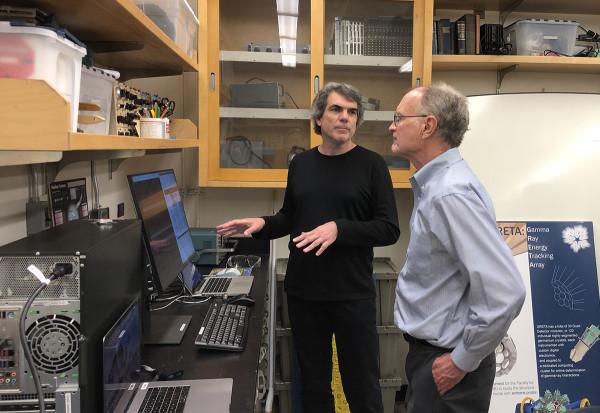
Pouyoul shows Berkeley Lab Director Mike Witherell an early prototype of the GRETA software pipeline.

