

HEP Case Study: DUNE and the Data of Neutrinos
By Sara Harmon, media@es.net
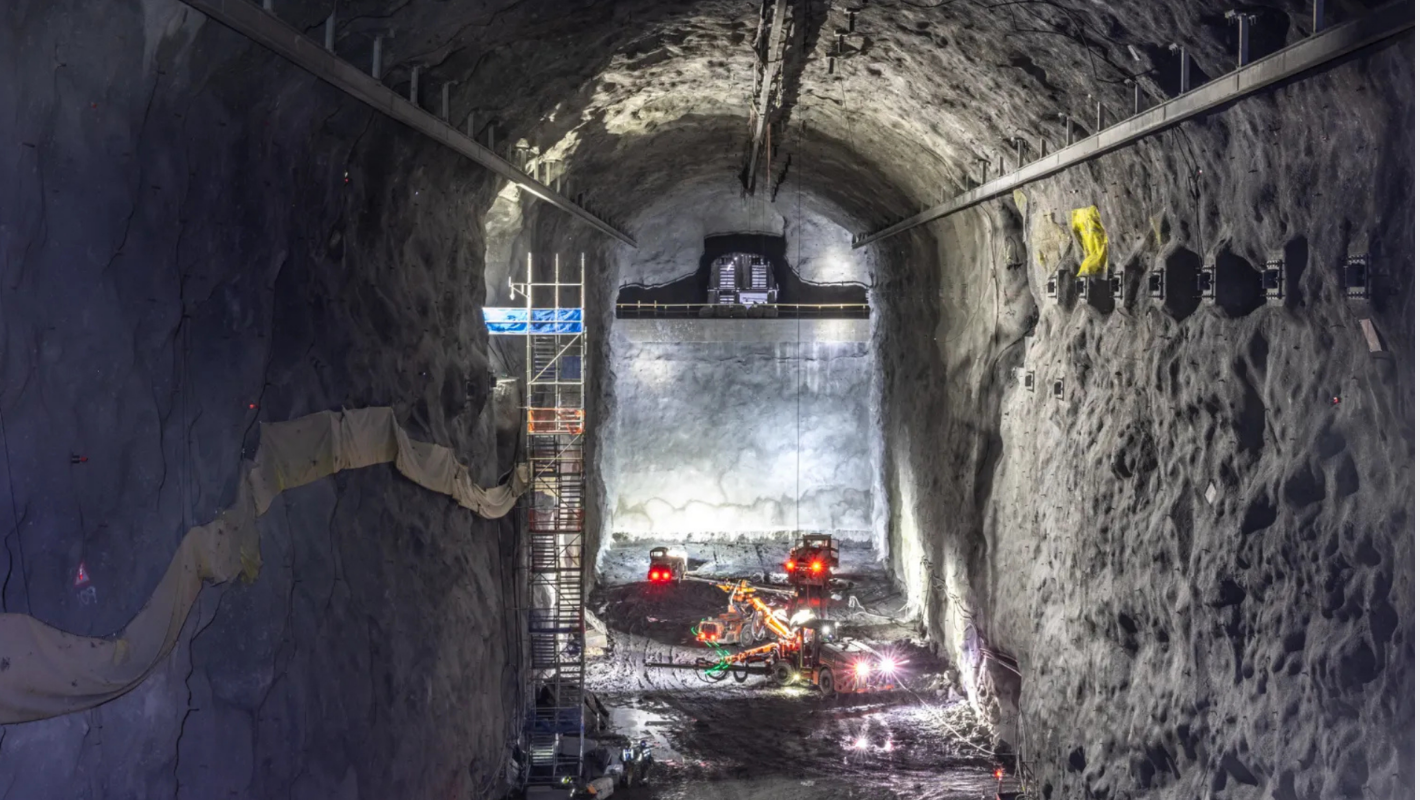
Cavern construction at the Sanford Underground Research Facility (SURF) in preparation for the DUNE experiment. Image Credit: Matthew Kapust, SURF
This article is part of a package about the ESnet HEP 2024 Requirements Review report, released on Oct. 1, 2025. The report details ESnet’s engagements with network users from the Department of Energy’s Office of Science High Energy Physics program and the process of assessing how the network meets, and will evolve to continue to meet, the data-heavy demands of modern scientific research. This is a synopsis of the DUNE experiment case study; see also the Vera Rubin Observatory companion case study.

There are more neutrino particles than any other type of matter, yet scientists don’t know nearly enough about how they function or their role in the universe. The Deep Underground Neutrino Experiment (DUNE), powered by the Long-Baseline Neutrino Facility at the Sanford Underground Research Facility (SURF) in South Dakota, has been tasked with finding the answers to these and other important questions. DUNE will begin construction in 2026 and is estimated to come online in 2029 and run for about 20 years.
Researchers plan to transfer neutrinos produced at Fermi National Accelerator Laboratory (Fermilab) in Batavia, Illinois, through 800 miles of dirt to DUNE far detectors in Lead, South Dakota. The far detectors are installed nearly 1 mile below the Earth’s surface. They are filled with liquid argon (-300 degrees Fahrenheit) which serves as both target and detector for neutrino interactions that can be tracked by sensors and then transmitted back to the surface as data.
Neutrinos have the ability to morph into different types, a phenomenon known as ‘neutrino oscillations.’ These neutrino oscillations make excellent probes to explore the unknown and fill critical gaps in our understanding of the universe. DUNE will compare neutrino and antineutrino oscillations to explore the question of why the universe is predominantly made of matter and also determine which neutrino is the heaviest (or lightest). The near and far detectors of DUNE are also capable of searching for new, unknown particles and interactions that go beyond the current framework of particle physics.
Another arm of the study focuses on naturally occurring neutrinos produced by supernovae. A supernova is the massive explosion that occurs when a giant star is dying: it runs low on fuel causing outward pressure and gravity to become imbalanced and the core collapse of the star creates an extremely powerful explosion.
Despite being at least several hundred light-years away, these explosions are actually very relevant to human life: they produce and scatter many of the heavy elements — such as zinc, iron, silver, tin, gold, mercury, lead, and uranium — that are used on Earth for energy production, electronics, jewelry, and even in the human body (i.e., the iron in our blood). And supernovae are also the primary source of neutrinos. Thus, the DUNE project relies on the SuperNova Early Warning System to alert researchers to a potential event, triggering the DUNE workflow. Because neutrinos from a supernova can be detected before the explosion is visible on earth, researchers can jump into action quickly to capture optical images of the explosion.
That’s where ESnet comes in. Data captured at the South Dakota site will be transferred via the ESnet6 backbone to Fermilab in Illinois for reconstruction, analysis, and storage. Data may also be sent to collaborators around the world through the Open Science Grid (OSG) and Worldwide LHC (Large Hadron Collider) Computing Grid (WLCG), for which ESnet provides trans-Atlantic connectivity and that within the United States.
While the workflow may sound straightforward, the massive amount of data is challenging to any network. In the case of a supernova detection, up to 600 TBs (the equivalent of 42,000 4K movies’ worth of data) needs to be collected in 100 seconds and then transferred about 800 miles within a few hours across the ESnet6 backbone, typically traversing across five Midwestern states (South Dakota, North Dakota, Minnesota, Iowa, and Illinois) quickly, reliably, and without interruption. This data will then be available to roughly 1,500 researchers from around the world to incorporate into their own experiments and analyses.
The network path must also have a minimum of triple redundancy, meaning that if anything goes wrong at one single point in the transfer, there are two backup options that don’t share any of the same connection points. Further, through the ESnet Requirements Review process DUNE researchers have determined a list of action items to address in the near future and the next two to five years, such as adding more connection to high-performance computing centers, to be ready when the experiment goes online and to grow with the demands and changing pace of science. This involves a lot of careful planning, partnership, and collaboration with multiple ESnet teams, research stakeholders, project sites, and vendors. After running for about 20 years, around 900PB of data is expected to have travelled over ESnet on its way to 35 different countries.
Read other case studies from ESnet’s High Energy Physics Requirements Review report.

