

Accelerating Science with Digital Twins
By
At the Department of Energy’s Lawrence Berkeley National Laboratory (Berkeley Lab), researchers are investigating and installing digital twins of highly sophisticated instruments that have the potential to dramatically speed up scientific discoveries.
A digital twin is a dynamic, virtual replica of a complex physical system such as a battery, manufacturing component, or a car. Digital twins have been used for decades in aerospace, healthcare, and manufacturing. While traditional simulations model a system based on fixed inputs, a digital twin uses real-time data from the physical system to model performance and predict future behavior.
Digital twins complement complex instruments by creating a continuous feedback loop. This allows the digital twin to adjust autonomously using real-time data updates and measurements — scientists accomplish this by combining advanced simulation, advanced sensors, and AI technology. The real-world counterpart delivers the precise measurements that feed and validate the models, while the digital twins use those measurements to explore scenarios and suggest real-time updates that would be impractical or time-consuming to complete without them.
Here are two examples of how ESnet is helping accelerate science with digital twins:
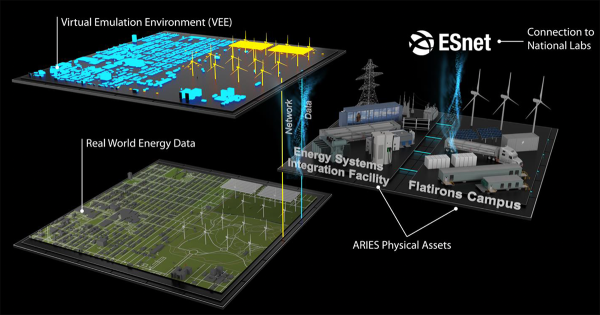
A visualization of the components for the Advanced Research on Integrated Energy Systems (ARIES) project, which creates a digital twin of an energy superfacility
High-performance networking for the future electric grid
As our energy systems grow increasingly complex, designing the next-generation U.S. power grid requires linking simulations and real-world testbeds across multiple national labs with data arriving exactly when expected. That’s where the Energy Sciences Network’s (ESnet) On-Demand Secure Circuits and Advance Reservation System (OSCARS) comes in. “A key challenge in connecting simulations to live equipment is ensuring data arrives exactly when it’s needed — even tiny delays can crash the system,” said Andrew Wiedlea, Science Engagement Acting Group Lead at ESnet.
By creating highly predictable, low-jitter network connections, ESnet enables projects such as the Department of Energy’s Advanced Research on Integrated Energy Systems (ARIES) project to synchronize complex models of nuclear plants, thermal batteries, and other grid components in real time. The ARIES project, led by the National Laboratory of the Rockies (NLR), aims to demonstrate real-time, AI-driven digital twins of critical energy infrastructure. Berkeley Lab’s FLEXLAB® — the world’s most advanced integrated building and grid technologies testbed — is a partner in the ARIES project, providing building energy simulation to test how future flexible energy loads from advanced HVAC systems could impact the grid. Working with the DOE’s Office of Electricity, the teams are exploring ways to scale this approach and connect utilities, universities, and other partners nationwide. (Read about the first ARIES digital twin experiment.)
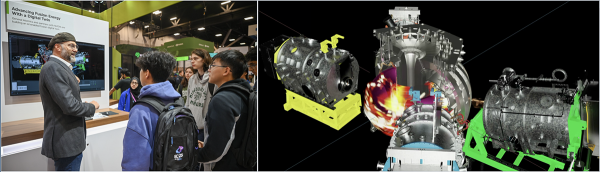
Left: Mark Kostuk, Leader of DIII-D’s Advanced Computing Group, explaining to students at SC25 how the digital twin works. Right: An image from DIII-D's interactive digital twin, in which surrogate machine learning models are used to rapidly calculate the plasma shape and position as well as the fast ion heat flux to the wall.
Perlmutter enables plasma predictions for fusion
General Atomics, NVIDIA, and collaborators from across the DOE complex have developed an AI‑enabled digital twin of the DIII‑D National Fusion Facility to help unlock fusion energy. This interactive virtual fusion device combines sensor data, physics‑based simulations, engineering models, and fast AI surrogates to let scientists test “what‑if” scenarios, refine plasma control strategies, and optimize reactor designs. To make this possible, fusion data moves through DOE’s high-speed data network, ESnet, to DOE supercomputers Polaris at Argonne and Perlmutter at Berkeley Lab’s National Energy Research Scientific Computing Center (NERSC), where key AI models are trained — reducing plasma behavior prediction times from weeks to seconds.
Read about more digital twins projects on the Berkeley Lab News Center.

