

Science Highlight: Building a Flexible Control Framework for Quantum Networks
QUANT-NET researchers have developed a novel control framework that enables automated, reliable control of quantum networks, paving the way for practical deployment.
Sara Harmon, media@es.net
The science highlight below was first posted on the U.S. Department of Energy Office of Science's Advanced Scientific Computing Research website.
In April, ESnet Executive Director Inder Monga, who is also lead P.I. for the QUANT-NET project, sat for a podcast interview about what the quantum internet will look like — and what it will take to build it. See Quantum @ ESnet for an overview of all ESnet's quantum networking projects.
The Science
Quantum networks will be essential as we scale up quantum computing. However, scientific communities must address many critical science and engineering challenges before we can deploy quantum networks in a practical way. To solve some of these problems, researchers have developed a new control framework for quantum networks. It consists of a centralized quantum network architecture, a scalable and extensible quantum control plane, and real-time quantum control software. For example, the framework includes a two-level scheduler to support network-wide non-time-critical tasks and node-wide time-critical tasks. When a user submits a request, the two-level scheduler translates it into a series of tasks. It then allocates these tasks to various quantum nodes in the network. This enables efficient and coordinated execution of quantum experiments across multiple distributed nodes. This system can also control and coordinate quantum networks across different locations. This accomplishment brings us a step closer to practical deployment of quantum networks.
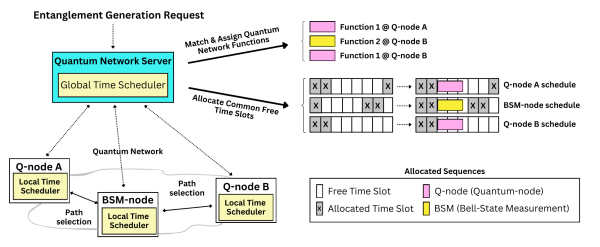
A diagram of the control framework developed for quantum networks by QUANT-NET researchers.
The Impact
As quantum networks extend to larger scales and get more complicated, they need to be managed by smart software rather than by people. It is becoming increasingly important to develop simple interfaces for users that mask the system’s complexity (a.k.a. quantum network abstractions), scale up network architecture and protocols, and automate software. This new control framework is modular and flexible. As a result, scientists can easily expand or change it to fit their needs. By supporting various real quantum devices and computer models, this framework helps researchers test different ways to build quantum networks.
Summary
The Quantum Application Network Testbed for Novel Entanglement Technology (QUANT-NET) researchers have made progress toward the automation of quantum network control and management. The team is deploying and evaluating their centralized quantum network architecture, scalable and extensible quantum control plane, and real-time quantum control software in the QUANT-NET testbed. This research has enabled several basic quantum network operations to be automated in the testbed. These operations include automated quantum node calibration, automated quantum link calibration, on-demand Bell State measurement, and on-demand single photon generation. This research marks a milestone on the road towards the practical deployment of quantum networks and the realization of a quantum internet.
Related Publications:
Monga I. et al, “QUANT-NET: A testbed for quantum networking research over deployed fiber.” QuNet '23: Proceedings of the 1st Workshop on Quantum Networks and Distributed Quantum Computing, 31-37 (2023). [DOI: 10.1145/3610251.3610561] [OSTI ID: 2572764]
Schon D. et al, “The QUANT-NET testbed development and preliminary results.” 2024 IEEE International Conference on Quantum Computing and Engineering (QCE), 1799-1808 (2024). [DOI : 10.1109/QCE60285.2024.00209] [OSTI ID: 2572772]
Yin Y. et al, “Experimental test of Bell-state measurement for narrow-band ion-photon interfaces in the QUANT-NET testbed.” Optical Fiber Communication Conference (OFC) 2025, paper M4E.4 (2025). [DOI: 10.1364/OFC.2025.M4E.4] [OSTI ID: 2572775]

