

Quantum Networking Research

ESnet's quantum networking researchers are collaborating on several projects to further quantum networking technologies. Their current focus is building a proof-of-concept testbed (the QUANT-NET project) for quantum network research and development – focusing on repeater-friendly quantum node technologies, quantum network architecture and protocol stacks, and high-efficiency quantum frequency conversion. Please connect with us on LinkedIn to follow our progress.
 Latest Quantum @ ESnet News
- Upcoming Speaking Engagements with Quantum @ ESnet researchers
- Science Highlight: Building a Flexible Control Framework for Quantum Networks
Current Research Activities
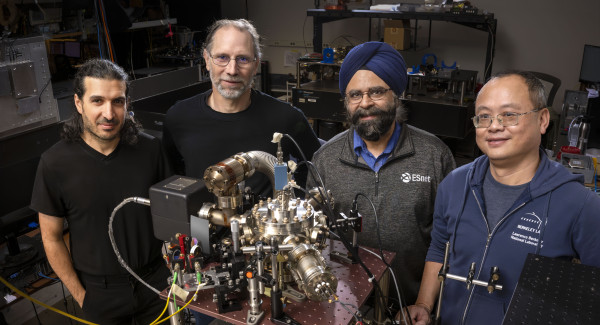
Left to right: QUANT-NET researchers Erhan Saglamyurek, Hartmut Häffner, Inder Monga, and Wenji Wu are working on a quantum network testbed connecting Häffner’s UC Berkeley physics lab to Berkeley Lab; others are building the infrastructure to allow ion traps to communicate and conducting color center research (see quantnet.lbl.gov/team). Photos: Bart Nagel Photography
Quantum Application Network Testbed for Novel Entanglement Technology (QUANT-NET)
Funded by the Advanced Scientific Computing Research (ASCR) program of the U.S. Department of Energy’s Office of Science, the Quantum Application Network Testbed for Novel Entanglement Technology (QUANT-NET) project brings together world-leading experts from Lawrence Berkeley National Laboratory (Berkeley Lab), University of California, Berkeley (UC Berkeley), the California Institute of Technology, and the University of Innsbruck to construct a testbed for quantum networking technologies.
The project’s goal is to establish a three-node distributed quantum computing network between Berkeley Lab and UC Berkeley, connected with an entanglement swapping substrate over optical fiber and managed by a quantum network protocol stack. On top of this entanglement swapping substrate, the research team will implement the most basic building blocks of distributed quantum computing and quantum repeater by teleporting a controlled-NOT gate between two far trapped-ion nodes.
QUANT-NET research efforts focus on three areas:
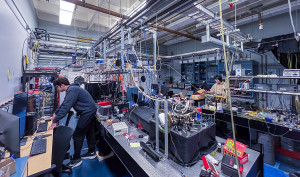
QUANT-NET researchers prepare for the OFC25 demo of the two-level control plane software
- Repeater-friendly quantum-node technologies, which include researching and developing trapped-ion quantum node (i.e., quantum computer) and color-center based single-photon source;
- Quantum frequency conversion of ion-compatible narrow-bandwidth photons at near-infrared 854 nm to the telecom C-band at 1550 nm;
- Quantum network control, architecture and protocol stacks.
The project also explores heterogeneity and a path toward scalability by researching and developing silicon color center–based quantum technologies that can be used in future quantum repeater platforms.
Visit the QUANT-NET website for the latest publications and talks.
Multi-platform quantum networking and computing (MP-QNC)
Funded by Berkeley Lab's Laboratory Directed Research & Development program (LDRD) program, “Exploring Atomic Ensemble Qubits for Distributed Quantum Computing” is a new multi-platform quantum networking effort within ESnet in collaboration with Berkeley Lab’s Applied Mathematics and Computational Research division and the National Energy Research Scientific Computing Center (NERSC). This collaborative effort will define the experimental and engineering pathways required to scale heterogeneous qubit technologies into distributed quantum computers. The researchers will also work closely with the QUANT-NET team, sharing ion-trap–based quantum networking nodes to accelerate the integration of heterogeneous qubit platforms into a distributed quantum network.
The research team will develop optical interconnects between different types of qubit systems, with the goal of demonstrating a quantum network that enables remote entanglement and quantum teleportation between atomic and solid-state qubits as a foundation for distributed quantum computing. The project will focus on laser-cooled neutral atoms and rare-earth-ion-doped crystals, and connect them via ensemble-based light-matter quantum interfaces. These systems will be further integrated with the existing trapped-ion platform to distribute entanglement across multiple qubit types. In parallel, the rare-earth solid-state system will be coupled to microwave resonators to explore future connections to superconducting qubits. The project will conclude with a demonstration of quantum gate teleportation between small-scale trapped-ion and neutral-atom processors, enabled by both single-atom and ensemble-based atomic qubits serving as optical interconnects.
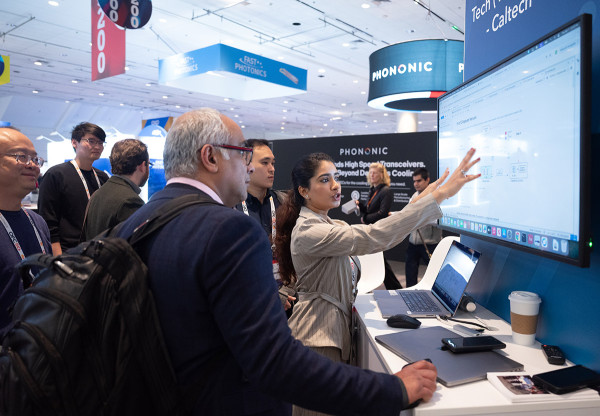
ESnet/QUANT-NET researcher Charu Jain demonstrates quantum repeater software at OFC 2025.
SEND-QC (Scalable Ensemble-enabled Neutral-atom Distributed Quantum Computing)
“Scalable Neutral-Atom Quantum Computing via Local-Area Quantum Communications Enabled by Atomic Ensemble Qubits” is a two-year DOE-funded initiative bringing together experts from ESnet and QuEra, a quantum computing startup. This government–industry collaboration offers a unique opportunity to help shape the future of data center–scale quantum computing by leveraging QuEra’s state-of-the-art technologies and the dynamic research environments of Berkeley Lab and UC Berkeley.
The SEND-QC project explores a novel optical interconnect approach for distributed quantum computing with neutral atoms. This research aims to integrate atomic ensemble qubits into optical tweezer arrays of single atoms, enabling quantum networking between state-of-the-art quantum processors and paving the way for scalable quantum computers. This project will involve theoretical and numerical analysis of Rydberg mediated interactions of a single atom with a micro-ensemble of atoms that can be used to collectively emit and store single photons for high-rate, high fidelity remote entanglement without the need of optical resonators. It will discover experimental and engineering directions needed to realize large-scale, fault-tolerant neutral-atom quantum computers.
QNPack: Full-stack and Accurate Modeling, Simulation of Quantum Networks from Local to National Scales
Existing quantum network testbeds and prototypes are typically implemented in laboratory experiments with limited functionality. To move these testbeds and prototypes from laboratory experiments to practical deployment of quantum networks, a few challenges need to be addressed: (1) to develop scalable network protocol architectures and protocols to automate quantum network control; (2) to build up a quantum network stack to support entanglement generation, distribution, and storage in quantum networks; and (3) to develop advanced quantum repeater technologies to scale quantum networks to long distances. These challenges are fundamental and common problems for quantum networks.
The QNPack project, funded by Berkeley Lab's Director's Research and Development program, seeks to address these challenges by focusing on three areas:
- Full-stack modeling and simulation of quantum network architectures and protocol stacks: Here,“full-stack” refers to the entire depth of a quantum network protocol stack, spanning from the bottom quantum physical layer to the top quantum application layer. The QNPack team explores a layered network protocol stack for quantum networks and tentatively assigns functions to each layer to realize quantum communication and networking.
- Advanced quantum repeater technologies research and development: We study and develop simulation models for “memory-based,” first-generation trapped-ion quantum repeaters, and “all-photonic,” entanglement-based quantum repeaters, incorporating models for mechanisms of control, entanglement generation and distribution, as well as extensible models for translating low-level physical features to the digital domain of quantum network operations.
- Theoretic study and comparative analysis of different quantum network paradigms: Our study and analysis have identified important quantum network performance metrics, including quantum network capacity, resource consumption requirements, reliability, and scalability. Such results can guide the research and development of quantum repeater technologies and the design and construction of large-scale quantum networks.
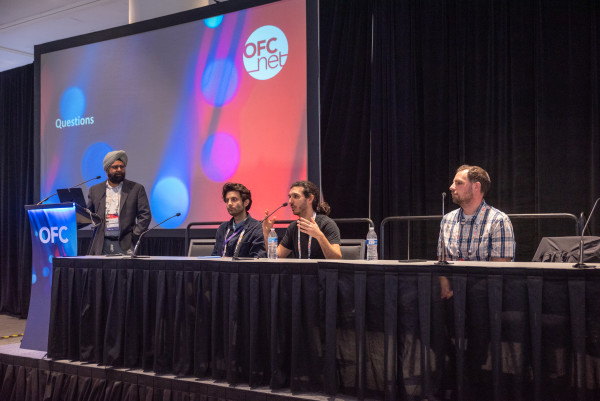
In this OFC25 panel, ESnet/QUANT-NET researchers Ehran Saglamyurek (center) and Ezra Kissel (right) shared the latest developments in remote entanglements and Quantum Repeaters (QR), respectively, while Davide Bacco of QTI (second from left) presented on Quantum Key Distribution (QKD). ESnet Executive Director Inder Monga (left), QUANT-NET lead P.I., moderated the panel.

