

Science Highlight: ESnet Supports First Fast Fusion Data Transfer Test of ITER to DIII-DNew Article Page
ESnet Communications, media@es.net
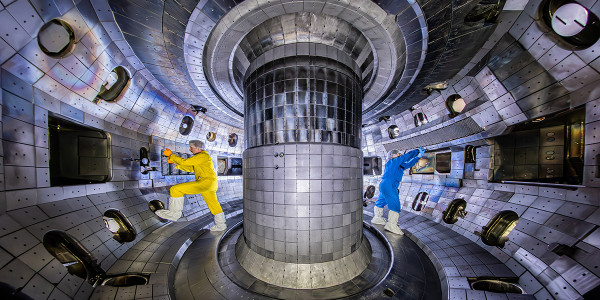
Inside the DIII-D National Fusion Facility tokamak
The Science
The goal of the ITER project is to build a nuclear fusion energy source that can be scaled to power the energy needs of the world’s nations. ITER operates under a “shared ownership” agreement comprising the international stakeholder governments of the United States, the European Union, India, Japan, the Republic of Korea, People’s Republic of China, and the Russian Federation. Currently under construction, the project is expected to achieve “first plasma” in 2033 or 2034. The reactor will be the largest tokamak in existence by about sixfold and will be the first fusion device to generate more heat than the fusion reaction uses to ignite, with an expected ratio of 10:1. ITER will deploy more than 60 diagnostic systems and subsystems that will collect data that will be transferred among ITER members.
The Impact
ITER is a collaboration of thousands of researchers from the seven members. Experimental data will be collected in Cadarache, France, and transferred to and stored in the international data distribution hub in Marseille before being delivered to member agencies. In summer 2025, ITER engineers conducted a large-scale data-transfer campaign to simulate the planned dataflow of moving terabytes (TBs) of data efficiently across 10,000 kilometers. Data transfers are expected to be 5 to 300 TB per shot, with a daily total of 30 to 2,000 TBs. A simulated First Plasma data set of 176 TBs — comprising more than 327,000 files — was transferred from the data storage center in Marseille to the DIII-D National Fusion Facility in San Diego, California, at an average speed of just under 80 Gbps. The best result achieved a full dataset transfer in just under 5 hours and 30 minutes. Despite the distance and protocol overheads, throughput remained close to the theoretical limit of the 100 Gbps link at 78.2 Gbps average. This achievement marks another step toward ITER’s long-term goal of establishing a global fusion data network, ensuring that all members of the ITER community can access and analyze experimental results in near real time.
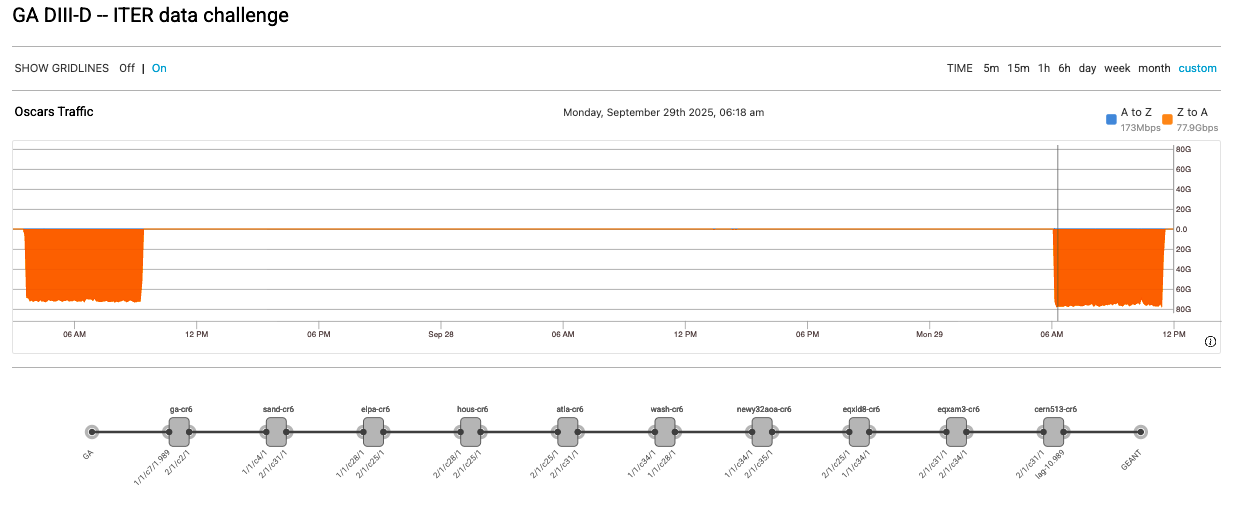
Network throughput graph showing the OSCARS dedicated 100 Gbps path for the DIII-D data challenge, the data transfer performance for an individual 176 TB test, and the ESnet portion of the end-to-end path between ITER and DIII-D.
Additional Details
The Cadarache site is connected to the Marseille center by two 400 Gbps circuits via dedicated dark fiber, which connects to Europe’s GÉANT network in Marseille via RENATER, which transfers the data to other carriers including ESnet. For the test campaigns, ESnet’s OSCARS (On-demand Secure Circuits and Advance Reservation System) handled the data transfer to DIII-D. ITER will require predictable, stable and redundant connections of 100–400 Gbps, which ESnet shows it can easily provide. ESnet will continue to collaborate on tuning and testing those network connections and on perfSONAR integration for performance monitoring.
ESnet Contact: Eli Dart, Science Engagement Team, engage@es.net.
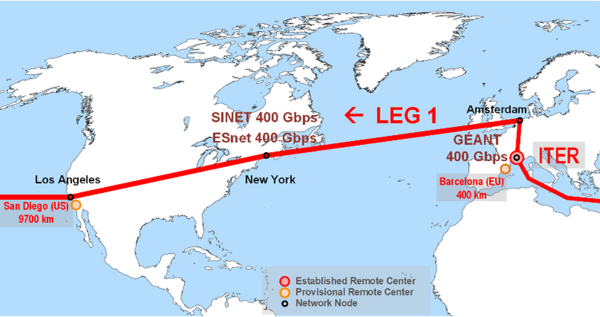
The path that the 176 TB dataset took from the data storage center in Marseille to the DIII-D National Fusion Facility in San Diego, at an average speed of just under 80 Gbps.
Collaborating Institutions
ITER Membership: The United States of America, the European Atomic Energy Community (Euratom); the Republic of India; Japan; the Republic of Korea; the Russian Federation; and the People's Republic of China.
Facility Collaborations
- ITER Scientific Data and Computing Center (SDCC), Cadarache, France
- Secondary Data Center – Marseille (Interxion / Digital Realty)
- High Performance Computing Facilities: DOE facilities NERSC, OLCF, PPPL, DIII-D; European facilities CINECA, EuroHPC systems; Japanese facilities IFERC / Rokkasho; and Korean, Indian, and Chinese domestic-agency HPC clusters.
- Partner networks: RENATER (France), GÉANT (pan-European), ESnet (USA), SINET (Japan), KREONET (Korea), CERNET/China Science Backbone, and the national networks of other member states.
Publications
ITER demonstrates fast data transfer to Japan and the US

