

DOE's AI Science Community Gathers at Confab26 to Share Progress on the American Science Cloud
By Bonnie Powell, media@es.net
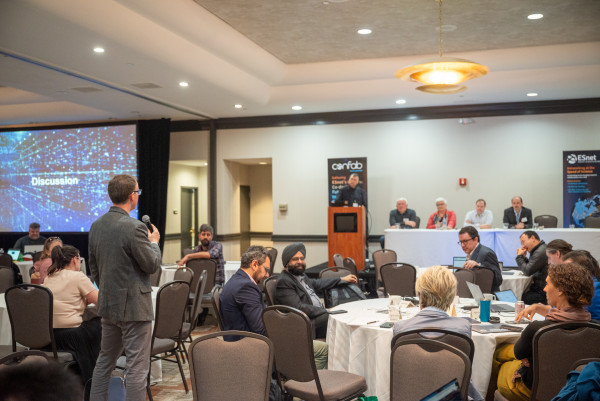
ASCR Facilities Director Ben Brown asks a question of the High-Performance Data Facility panel
This year’s ESnet’s user meeting, Confab26, was hosted in close partnership with Genesis Mission and American Science Cloud (AmSC) leadership, and matched the scale of the challenge that the Department of Energy (DOE) has set itself. The Genesis Mission seeks to double the productivity and impact of American science and engineering within a decade by integrating AI, advanced computing, and the DOE national laboratory system into a unified discovery platform. AmSC is the DOE-governed, federated cloud platform that will unify data, models, and high-performance computing resources across the national labs, commercial cloud providers, and frontier AI companies and serve as a key part of the Genesis Mission platform. Underpinning this infrastructure are the science-dedicated networking and network services of ESnet.
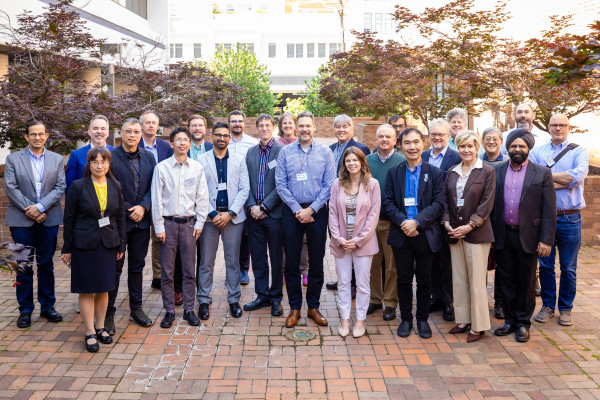
Confab26's keynote speakers and panelists pose with DOE Genesis and AmSC leadership
Roughly 250 scientists, engineers, and DOE leaders convened in Rockville, Maryland, from May 12-14 for Confab26. Nine keynote speakers, more than twenty technical demonstrations, and four lively panel discussions filled the three days, punctuated by a working dinner on quantum computing. Breakout rooms provided additional space for interactive demonstrations and discussion, while constant sidebar conversations took place at tables and in hallways between infrastructure teams working to solve shared problems in real time.
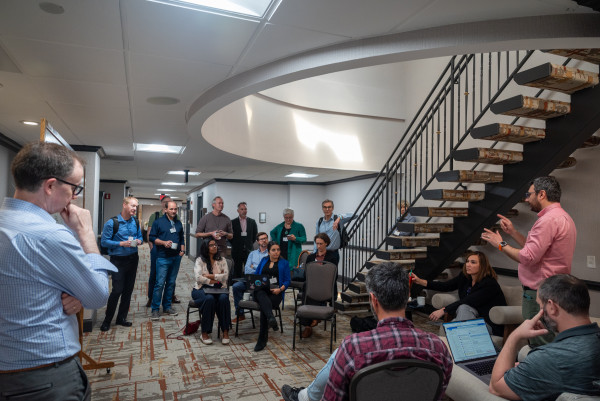
DOE ASCR and AmSC leadership gathered in a hallway for an informal discussion
Confab26 was ESnet's largest user meeting yet — and a clear signal of how central its network and staff are to DOE's AI plans. As an AmSC Infrastructure Partner (IP), ESnet builds on its early stewardship of the DOE Integrated Research Infrastructure (IRI) program that AmSC now extends. ESnet's role in AmSC runs deep, extending into the project's core leadership and technical architecture. ESnet Executive Director Inder Monga serves as AmSC's Deputy Project Lead, coordinating the platform's overall implementation with Project Lead Gina Tourassi, Associate Laboratory Director of the Computing and Computational Sciences Directorate at Oak Ridge National Laboratory (ORNL). ESnet Chief Technology Officer Chin Guok leads the integration of all the Infrastructure Partners (IPs), the DOE labs that are contributing and integrating core capabilities into AmSC, while other ESnet staff co-lead technical workstreams spanning federated identity, the AmSC and IRI APIs, platform monitoring, resource orchestration, cloud platform engineering, and the wide-area data fabric connecting it all. This leadership reflects ESnet’s essential role in advancing DOE Office of Science mission science, over the past 40 years of science-dedicated networking.
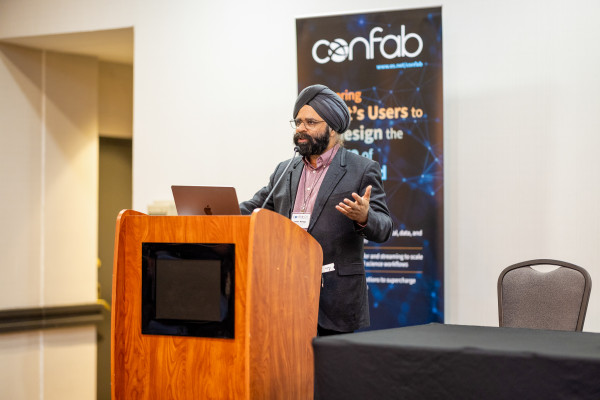
Monga welcomed the AmSC Infrastructure Partners community to Confab26
“We launched Confab in 2022 as a series of ‘fabulous conversations’ built around our core principle of codesign with our science users,” said Monga. “It was a natural extension to combine that approach with a focus on IRI in 2025, and now for the American Science Cloud. Just as ESnet’s fiber-optic network interconnects all of the labs and user facilities, ESnet’s human network provides a trusted fabric through which all of these DOE fusion, light-source, nuclear physics, and other teams can collaborate — not just with us, but with each other.”
DOE Leadership Sets the Stakes
In his opening keynote for Confab26, DOE Under Secretary for Science and Innovation Darío Gil, who leads the Genesis Mission, described the American Science Cloud as "fundamental infrastructure" that is essential to the mission's success.
"Your progress on this is truly incredible," he told the room. "Thank you for the long hours, creativity, and urgency you have brought to this effort."
Gil then moved from the podium to an armchair for a fast-paced discussion with Monga and Tourassi, fielding audience questions on public-private partnerships, the role of academia, open-source software, and quantum computing. "We're here to take risks," Gil told attendees. "It's essential to our jobs."
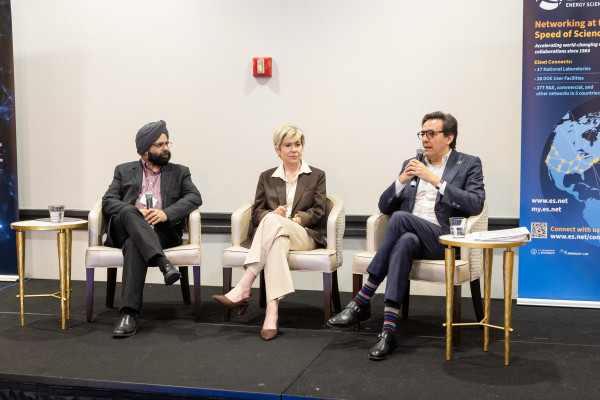
ESnet Executive Director Inder Monga and Oak Ridge National Laboratory Associate Laboratory Director Gina Tourassi, who are the American Science Cloud (AmSC) project deputy and lead, respectively, with DOE Under Secretary for Science and Innovation Darío Gil, who leads the Genesis Mission, during their fireside chat at Confab26.
On the second morning, DOE Advanced Scientific Computing Research (ASCR) Associate Director Hal Finkel gave a more informal status update on Genesis and AmSC progress, followed directly by an open audience Q&A. His candid responses and quips such as the challenge of “vibe-maintaining your vibe-coded software” put the audience at ease.
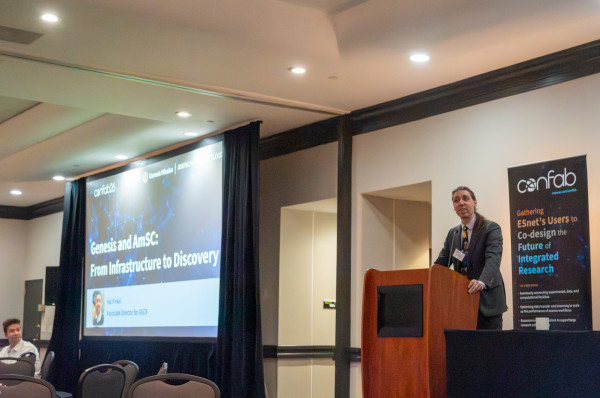
ASCR Associate Director Hal Finkel gave an informal keynote
Demonstrating Progress
Confab26's programming was built around demos by AmSC Infrastructure Partners, the teams that integrate resources — including physical infrastructure (e.g., compute, storage, network), services (e.g., data curation, inference), and data — into the AmSC ecosystem to offer additional capabilities for all AmSC scientific workflows.
Dozens of experts from across the labs and user facilities shared their work on 10 IP projects over the course of the meeting. Each of the 21 teams was required to give a 15-minute plenary talk about their progress that included an illustrative video; they could also reserve time in a breakout room to walk attendees through a live demo and to answer questions, and most did so. (Check out the short demo videos from six of the IPs that are available on the AmSC website.)
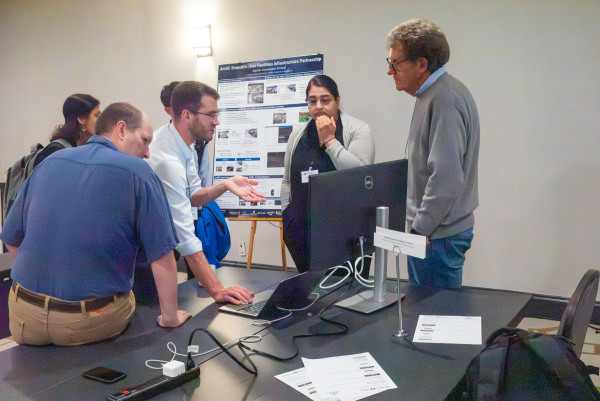
AmSC IP teams gave drop-in demos in three breakout rooms, augmented with posters
The demos spanned nearly every corner of DOE science — from AI-driven structure identification at Brookhaven's light source beamlines, to agentic accelerator controls at Berkeley Lab, to multi-agent workflows for nuclear reactor design at Idaho National Laboratory — each one testing a different piece of science infrastructure for the AI era. The Scientific User Facilities Infrastructure Partnership (SUF IP) team, for example, presented five demos spanning accelerator physics, nuclear physics, high energy physics, and light and neutron source science — proof that AmSC's core services (the IRI API, Data and Model Catalogs, MLflow, and data transfer tools) can support widely different workflows on common infrastructure. The fourth SUF IP showcase packed in five sub-demos on its own, ranging from end-to-end tomography reconstruction to real-time Bragg peak detection at LCLS to a natural-language interface for exploring beamline data, illustrating how light and neutron facilities across SLAC, Argonne, Berkeley Lab, and Oak Ridge are converging on a shared, AI-ready computing fabric.
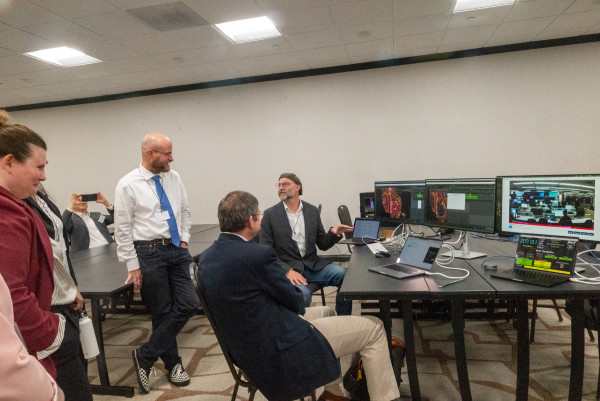
The DIII-D team gave a live demonstration of how AI can speed the analysis of data from a fusion experiment
To add a little friendly competition to the conference, AmSC leadership suggested an informal best-demo contest, with votes tallied on the last day. The winner was the Interactive DIII-D Digital Twin for Experimental Science demo presented by Sterling Smith, Mark Kostuk, and David Schissel of General Atomics' Magnetic Fusion Energy Division, which operates the DIII-D National Fusion Facility in San Diego. On the meeting's second day, the team pulled off a live demonstration synchronized with actual operations, running faster-than-real-time predictive simulations that gave operators viable options for improving an experiment in progress — an impressive feat given the cost and complexity of tokamak fusion research. For their plenary presentation, they walked the audience through how they built it: surrogate models trained on IRI-obtained datasets, tuned with MLflow, and executed remotely at NERSC and the Argonne Leadership Computing Facility, with a natural-language interface enabling operators to query simulated data on the fly.
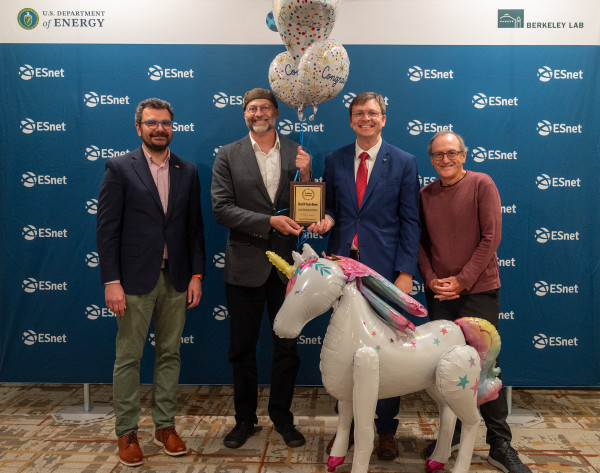
DOE’s then–Advanced Computing Technology Division Director Pavel Lougovski (left) presented the DIII-D team with a plaque for winning the informal Best Demo contest, and the Confab organizing team surprised them with celebratory balloons.
The Bigger Conversation
Amid the discussion of the AmSC ecosystem, much of which relies on the ESnet infrastructure, ESnet also carved out space for its own updates. In honor of ESnet’s 40th anniversary, Monga opened the meeting with a look at ESnet's evolving role over the decades and teamed up with Guok to discuss the future of the intelligent network. ESnet experts delivered short talks on innovative services and advanced technology — including High Touch telemetry, measurement and analysis tools, pilot projects, advanced wireless research, and quantum networking — that are either already enabling AmSC successes or will soon.
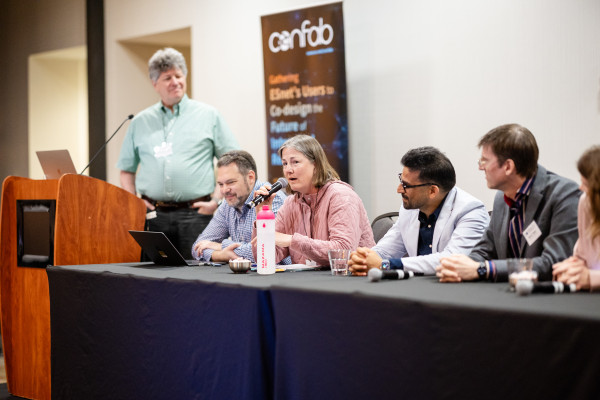
The AmSC Science Council's panel on "Big Science in the Age of the Genesis Mission"
Two dozen high-profile keynote speakers and panelists also offered additional food for thought throughout the conference. Day One began with a lively panel discussion on "Big Science in the Age of the Genesis Mission," featuring members of the AmSC Science Council from Oak Ridge, the Joint Genome Institute, Fermilab, Pacific Northwest National Lab, and Jefferson Lab. It was followed by talks on the Vera C. Rubin Observatory data pipeline, the National Nuclear Security Administration’s AI collaboration, international AI-for-science efforts from RIKEN's Satoshi Matsuoka, and more. Days Two and Three featured a panel exploring AI-driven science workflows, with leaders from Argonne, Berkeley Lab, and General Atomics; one on data streaming to High Performance Computing, featuring ESnet, Globus, and Oak Ridge experts; and a discussion of the High Performance Data Facility's role in powering AmSC data services.
The final panel, "Cyber Security in an AI Science Era," was moderated by ESnet Chief Security Officer Adam Slagell and gathered security leaders from Argonne, Oak Ridge, Berkeley Lab, ASCR and the Genesis Mission. It was a fitting close to a program that moved from vision-defining keynotes through domain-specific deep dives to the shared infrastructure and security innovations tying it all together.
Confab27 will be held the week of May 10, 2027, once again in the Washington, D.C., area. To be notified when registration opens, please sign up for our mailing list.
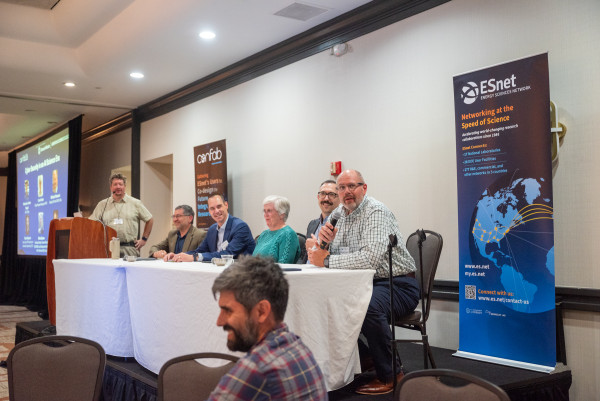
The "Cyber Security in an AI Science Era" panel was moderated by ESnet Chief Security Officer Adam Slagell and gathered security leaders from Argonne, Oak Ridge, Berkeley Lab, and the Genesis Mission itself

