

ESnet Turns 40

Although officially formed 40 years ago in 1986, the Energy Sciences Network’s roots stretch back to the mid-1970s, when staff at the CTR Computer Center at Lawrence Livermore National Laboratory installed four acoustic modems on a borrowed Control Data Corp. 6600 computer and connected it to ARPANET.
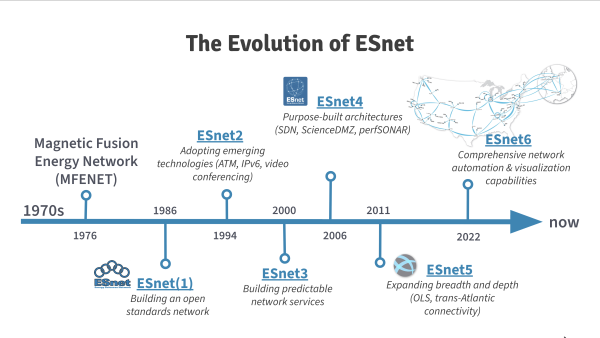
The network now known as ESnet was created in October 1986 as a merger between the Magnetic Fusion Energy Network, or MFEnet — which connected Livermore's Magnetic Fusion Energy Computing Center to researchers at General Atomics, Los Alamos, Oak Ridge, and Princeton Plasma Physics Lab — and the High Energy Physics Network, or HEPnet. ESnet began offering networking services less than two years later.
READ MORE
"Four Decades of Accelerating Science: ESnet Turns 40," October 2026 feature
Since then, the ESnet network has gone through six distinct iterations, won numerous awards, and achieved many milestones in networking. Today it is America’s premier network dedicated to scientific research, supporting Department of Energy-funded collaborations around the globe as well as serving as the backbone of the Genesis Mission’s American Science Cloud platform.
40TH ANNIVERSARY EVENTS








We're celebrating in person, virtually, and on social media (follow #ESnetTurns40 on LinkedIn).
Nov. 4 Virtual Celebration: Wednesday, Nov. 4, 10am-1pm Pacific Time
SEE SCHEDULE AND REGISTER NOW
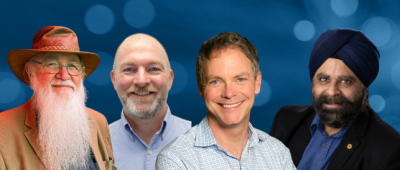
Former ESnet heads Bill Johnston, Steve Cotter, and Greg Bell, and current Executive Director Inder Monga will participate in a Directors' Roundtable Q&A
-
- ESnet Directors' Roundtable Q&A with Bill Johnston, Steve Cotter, Greg Bell, and Inder Monga, whose tenures span ESnet3 through ESnet6
- Toasts and flash talks from DOE, Lab, facility, and R&E partners and current/former staff
- ESnet history trivia
- Breakout-room socializing, grouped by ESnet era
Register now to see the schedule and receive the Zoom link and reminders!
Nov. 16 Celebration at SC26 in Chicago
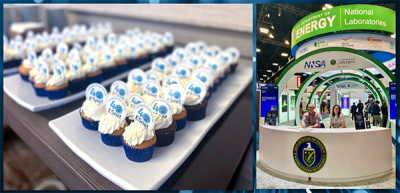
November 16, 2026, 7:30-9pm Central Time, at the DOE Booth at Supercomputing 2026: RSVP here (not required)
WHAT COLLABORATORS HAVE TO SAY ABOUT ESNET
Sign our guestbook, and share your ESnet story with us!
 "To me, ESnet is about smart data transport for streaming science. ESnet’s network has been essential for our real-time distributed data streaming work, enabling high-bandwidth data movement between Jefferson Lab and remote computing facilities. ESnet has helped us move from isolated demonstrations toward realistic distributed workflows, where experimental data can be streamed efficiently from instruments to remote processing facilities. Their network provides the enabling infrastructure, and the expertise of ESnet staff has provided the practical technical guidance needed to use that infrastructure effectively."
— Vardan Gyurjyan, Staff Scientist, Jefferson National Accelerator Facility
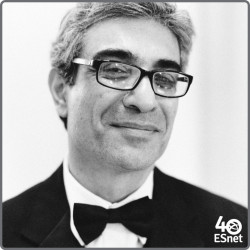
 "I've been using ESnet since my arrival at CERN in 2002. ESnet deployed some of their best engineers at CERN to kick off and ramp up their trans-Atlantic and European network to better connect CERN to the U.S. members of the LHC collaborations. Each of them stayed at CERN for one year and that was an enriching experience for our network team. ESnet has also been a driving force in the design and implementation of the LHCONE network that now carries a large part of the world’s science traffic. ESnet enables big science while innovating networking."
—Edoardo Martelli, Network Engineer, CERN
 "I have been using ESnet for more than 30 years. It's fast and it works! I have worked long and closely with ESnet staff on many different things — reviews, committee reports, special projects, proposals. One that stands out is the Petascale data transfer project, which came out of discussions with ESnet staff based on a talk I gave at a Cross-Connects meeting in 2015. Our initial goal was to transfer about a petabyte a week of data across the major DOE and NSF computing facilities and eventually we got it to a petabyte a day, which was an impressive achievement!"
—Salman Habib, Computational Science Division Director, Argonne National Laboratory

