Four Decades of Accelerating Science: ESnet Turns 40
From 56 Kbps lines to 1.6 terabits per second, the network that connects DOE science has changed almost everything except its purpose: erasing distance to speed breakthroughs in fusion, physics, cosmology, and other vital scientific fields.
Bonnie Powell, media@es.net
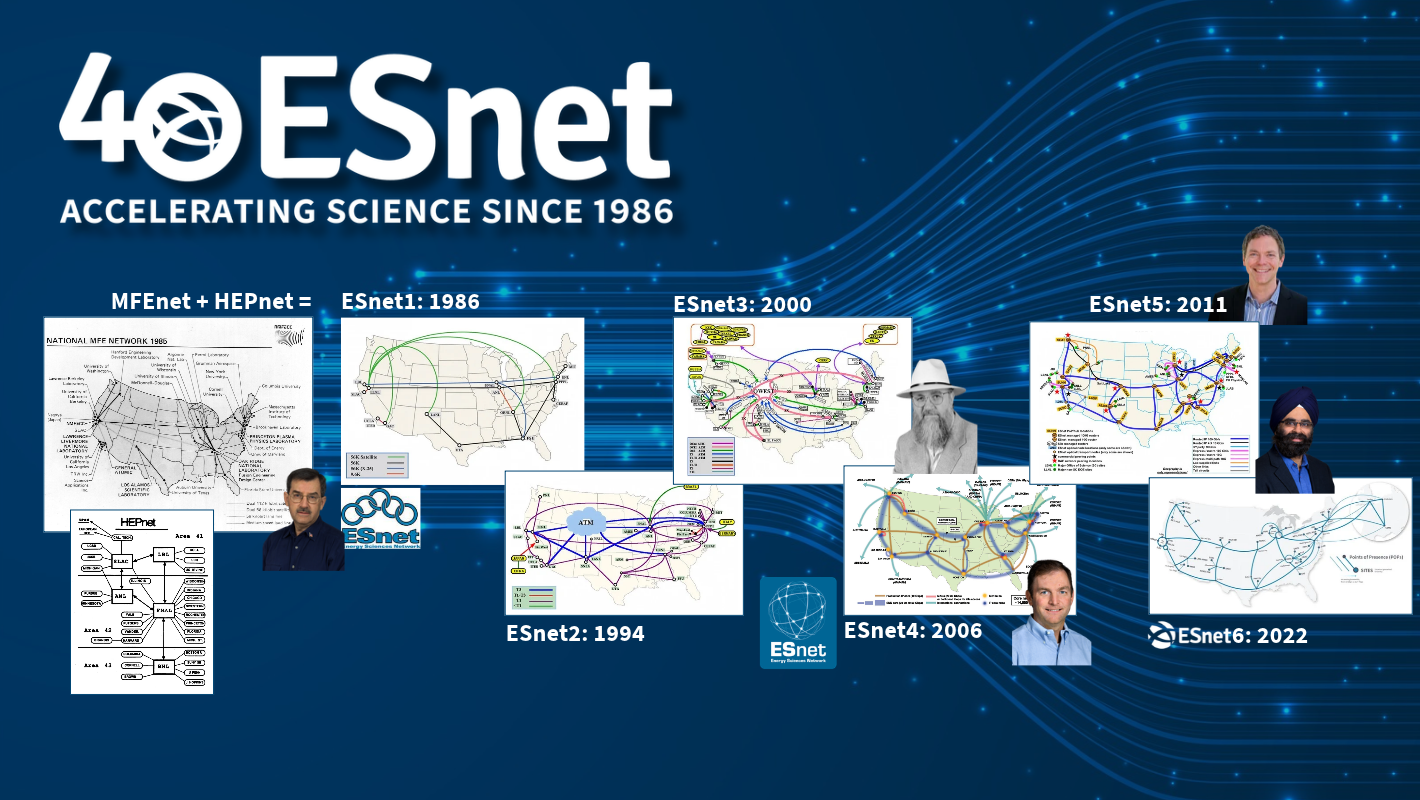
ESnet’s network was born from the merger of the Magnetic Fusion Energy network (MFEnet) and the High Energy Physics network (HEPnet). It has evolved through six distinct iterations under the leadership of five directors. (Enlarge)
In 1994, a few years after the Energy Sciences Network (ESnet) launched, the busiest month saw about 1.8 terabytes of data. These days, ESnet can move that much data in around nine seconds.
That’s how far ESnet has come since its origin in 1986. Its top link speeds are now about 28 million times faster than its original 56 Kbps lines, and in 2025 it carried 2.5 exabytes of data, or roughly 100,000 times more data per month than that 1994 peak.
Join the Celebration
ESnet is marking our 40th anniversary in person, online, and on social media.
Learn more at www.es.net/40 — or scroll to the end.
Yet ESnet's vision has remained almost unchanged. A 1996 program plan for its funding agency, the Department of Energy, described "a future in which advanced network capabilities enable seamless collaborations for DOE and its researchers," with scientists "unencumbered by geography or time." The current version? "Scientific progress will be completely unconstrained by the physical location of instruments, people, computational resources, or data."
To fulfill that goal, ESnet’s human network has played an increasingly important role. From the very beginning, engineers collaborated with scientists to make sure the network would work for their needs; as their requirements evolved, so did ESnet’s approach to collaborative innovation, or “co-design.”
A Network Built for Science
ESnet's story starts with the U.S. government's focus on fusion energy research in response to the energy crisis of the 1970s. In 1974, the Atomic Energy Commission launched a computing center at Lawrence Livermore National Laboratory for fusion scientists, subsequently named the National Magnetic Fusion Energy Computer Center (NMFECC). The network linking it to labs across the country was called MFEnet.
By the mid-1980s, networking had become necessary for Big Science. On October 7, 1986, Alvin Trivelpiece, then head of DOE's Office of Energy Research (which later became the Office of Science), approved the proposal to combine MFEnet with HEPnet, which served high energy physics, thus creating the Energy Sciences Network.
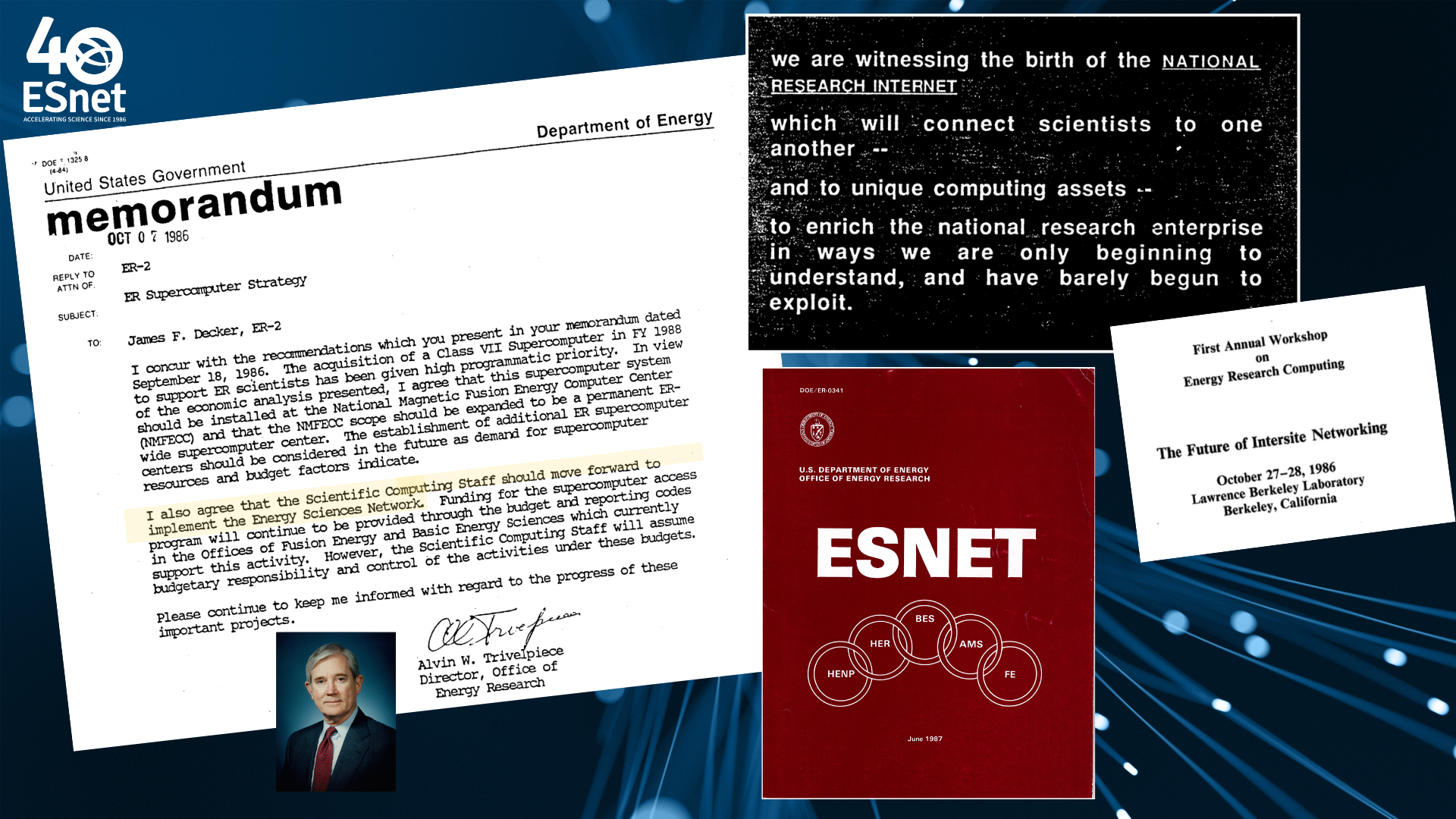
Left to right: The Oct. 7, 1986, memo from Alvin Trivelpiece authorizing the creation of the Energy Sciences Network; a 1986 comment from Steven Wolff, then the National Science Foundation’s director of networking, at the groundbreaking October 1986 conference on the Future of Intersite Networking at Berkeley Lab; the cover of ESnet’s program plan, featuring its first first logo, with five rings for the five Energy Research science programs. (Enlarge)
Later that month, the first workshop on energy research computing was held at Lawrence Berkeley National Lab. Its focus was “The Future of Intersite Networking,” and it was the must-attend conference of its time.
“Right from the start of this session it was clear that no scientist wanted networking to be in the way of his scientific computing. The closer a network was to being totally transparent, having infinite bandwidth, and being very cheap, the more appealing it would be to the E.R. Scientific Community,” wrote Sandy Merola, who later chaired ESnet's steering committee, in the workshop's follow-up report.
Want even more history? Check out this timeline made for the 2022 launch of ESnet6.
Together, the NMFECC staff and the user community hashed out the requirements for the new network. To recognize its users, ESnet’s first program plan, in 1987, sported a five-ring logo representing the five Energy Research offices it would serve, and the merged ESnet began providing network services in January 1988.
Growing Up with the Internet
ESnet’s first two decades were a race to keep up with demand — and to do so as cost-effectively as possible, as commercial Internet Service Providers were always knocking at DOE’s door.
And yet it was marked by many technological firsts. Around 1990, ESnet replaced MFEnet's 56 Kbps lines with commercially supplied routers running on T1 links at 1.5 Mbps. It also went international, with links to Japan, Germany, CERN, and the United Kingdom. DOE and academic researchers across ESnet were using rudimentary yet functional videoconferencing to collaborate on massive scientific endeavors — the first of the innovative networking services that ESnet would offer over the years.
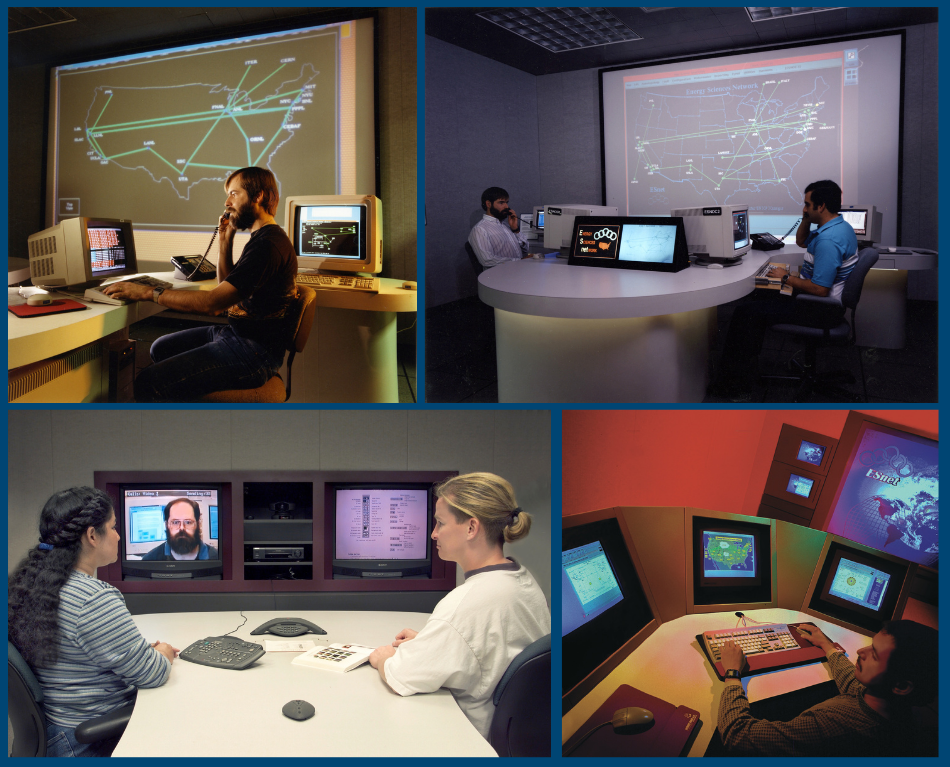
Archival 1990s ESnet images courtesy of Lawrence Livermore National Laboratory; bottom left shows ESnet’s first fully remote employee, Joe Metzger, on screen around 1998. (Enlarge)
In 1994, T3 lines raised the backbone to 45 Mbps, and ESnet became the first major network to convert to Asynchronous Transfer Mode. In 1996, ESnet moved to Berkeley Lab (along with the NMFECC’s successor, the National Energy Research Scientific Computing Center, NERSC) and became a standalone department.
By the mid-1990s, researchers were already doing things that would have been impossible a decade earlier. MIT's Alcator C-Mod tokamak was run over ESnet from a control room 3,000 miles away at Livermore Lab, which MIT's Martin Greenwald described as the first remote operation of a major magnetic fusion experiment from across the country. Elsewhere, ESnet enabled an analysis of plasma images from the DIII-D tokamak to be split across 44 workstations at NERSC, General Atomics, and Livermore. Fusion was part of ESnet's origin, and 40 years later the work continues: this past May, researchers moved a 176-terabyte dataset from ITER's data center in Marseille to DIII-D in San Diego at nearly 80 gigabits per second via ESnet.
In 1999, ESnet requested and was assigned the very first production IPv6 addressing prefix by the American Registry for Internet Numbers (ARIN). Twenty-seven years later, ESnet remains the leader in championing this Internet protocol.
The Start of Formal Co-design
In 2003, as ESnet’s third decade approached, legendary computer scientist Bill Johnston was hired to lead the organization and drove a fundamental change in its strategy.
“When I joined ESnet, the organization was totally focused on ESnet as a production network, with the leadership deciding the directions and the needs of the users,” said Johnston in an interview before his retirement in 2008. “We needed to make a solid connection between the network and the science needs of the Office of Science.”
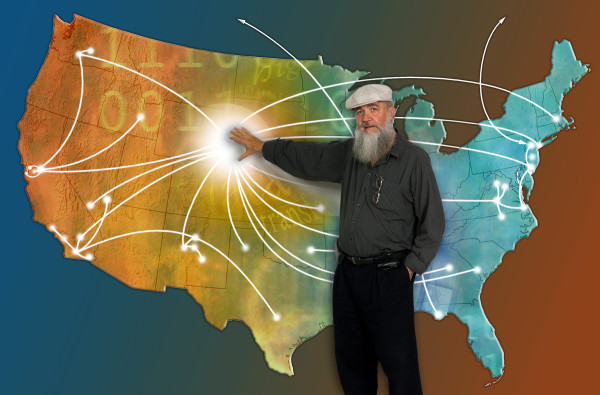
ESnet’s second director, Bill Johnston, in 2003.
Johnston led a complete reanalysis of the network requirements of DOE's science programs, enlisting several members of the ESnet network engineering group to work directly with scientists and user facilities. This was the beginning of ESnet’s dedicated codesign focus, embodied by its Requirements Review program, and it drove preparations for the Large Hadron Collider (LHC) coming online at CERN in Geneva in 2008. The LHC was the first new large-scale scientific instrument to be designed to rely on a global network, and the ESnet3 network of 2003 was not ready to handle it.
Johnston also saw clearly the importance of building ties with research & education (R&E) networks worldwide.
In 2006, to prepare for the LHC and to broadly support high performance computing and data-intensive science, ESnet and Internet2 announced a partnership to build ESnet4. The two organizations also collaborated on a prototype service to enable on-demand provisioning of guaranteed bandwidth. ESnet’s OSCARS (On-Demand Secure Circuits and Advance Reservation System) was designed specifically to meet the science-driven network requirement of dynamically provisioned quality of service (QoS) paths, as outlined in the requirements gathering process. OSCARS remains ESnet’s scientific workhorse to this day.
In addition, it was clear that the R&E networks needed to collaborate to ensure the high performance levels necessary for enabling science. In 2005, ESnet teamed up with Internet2, GÉANT, and other R&E networks to develop perfSONAR, a measurement toolkit that lets engineers and scientists pinpoint performance problems across the many networks a dataset may cross. perfSONAR now has more than 2,000 registered instances deployed by over 1,000 organizations worldwide, and has become a standard companion to the Science DMZ (read on).
Hired away from Google to lead ESnet in 2008, Steve Cotter continued on the outward-facing path that Johnston had set, including the formalization of ESnet’s Science Engagement group, which works directly with scientists and science programs to maximize ESnet’s benefit to science. Cotter led ESnet’s successful completion of the largest American Recovery and Reinvestment Act project at Berkeley Lab, which built the Advanced Networking Initiative (ANI) network, the first 100-gigabit continental-scale network, and acquired the fiber-optic cables that carry ESnet traffic today.
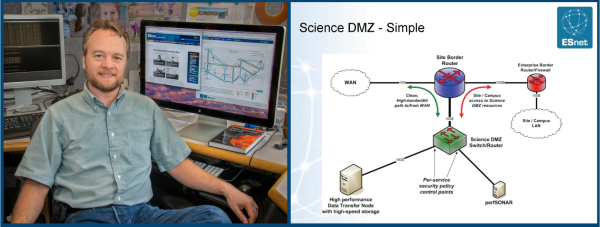
ESnet Science Engagement engineer Eli Dart in 2014 with the Science DMZ, the network design for optimizing science data transfers that he helped popularize.
Around that time, ESnet Science Engagement engineer Eli Dart led the introduction of the Science DMZ, a scalable network design model for optimizing science data transfers. The Science DMZ was adopted first by the National Science Foundation and then hundreds of universities. It remains a mainstay of the research & education networking community. ESnet received multiple awards for both OSCARS and the Science DMZ.
In 2012, Cotter was succeeded by Greg Bell, a longtime Berkeley Lab staff member and leading technologist. ESnet5 went into production a few months later, in November 2012, at 100 gigabits per second, ten times faster than its predecessor and billed as the world's fastest science network. ESnet had become a Berkeley Lab division in the Computing Sciences Area, and the organization scaled up to meet the demands of running ESnet5 as well as expanding overseas, with four trans-Atlantic cables and teaming up with GÉANT to build a ring network in Europe.
Meanwhile, the LHC quickly became, and remains, the biggest single source of ESnet data traffic. Edoardo Martelli, a network architect and senior staff member at CERN who has used ESnet for more than two decades, recalls that "ESnet deployed some of their best engineers at CERN to kick off and ramp up their trans-Atlantic and European network," and says ESnet has been "a driving force in the design and implementation of the LHCONE network that now carries a large part of the world's science traffic."
The LHC continues to shape ESnet's trans-Atlantic strategy, such as the trans-Atlantic subsea spectrum lease ESnet signed in 2024, its first. Now it is building additional capabilities for the High Luminosity LHC era, which will produce roughly ten times more collision data and sharply increase data volumes.
Bigger, Faster, Smarter
ESnet’s fourth decade began with ESnet then-CTO Inder Monga taking the reins in 2016 from Greg Bell. Almost immediately, Monga embarked on the organization’s most ambitious effort yet: a complete overhaul of the design of the network, without any disruption to its tens of thousands of users. To do so, it had to staff up — way up: under Monga’s tenure, the organization has tripled in size, to around 150.
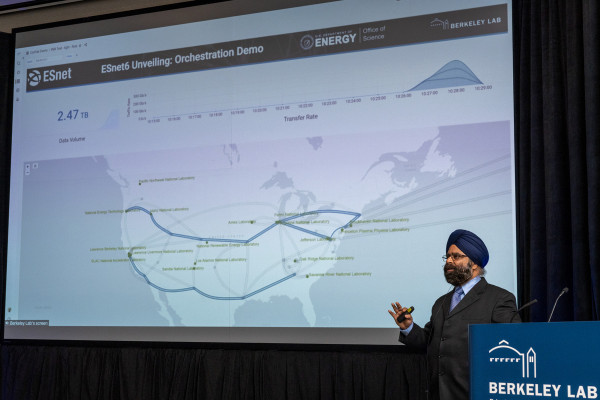
ESnet Executive Director Inder Monga at the 2022 unveiling of ESnet6.
In October 2022, ESnet unveiled ESnet6, which was completed more than two years ahead of schedule and under budget, despite the global pandemic and disrupted supply chains. The new network boasted an expanded, dedicated fiber-optic backbone with centralized orchestration and automation, real-time telemetry, and improved cybersecurity. ESnet6 also brought even more capacity (85 Tbps of aggregate backbone capacity) and speed: as of 2026, backbone links range from 400 Gbps to 1.6 Tbps.
“ESnet6 is a turning point in design and architecture,” said Vint Cerf at the ESnet6 launch ceremony. Widely considered one of the “fathers of the Internet,” Cerf served on ESnet’s policy board for many years. “It is no mean feat to continue to serve a demanding community while literally introducing a dramatic upgrade, not only in capacity, but also in flexible architecture and management.”
As part of the ESnet6 launch, ESnet held the first annual gathering of its science users, which it dubbed "Confab." It has continued to do so ever since, bringing together researchers from around the DOE science ecosystem, both familiar faces and new ones, such as from the Vera C. Rubin Observatory. Rubin is using the world's largest digital camera to inventory the universe and probe the nature of dark matter and dark energy. ESnet plays a key role in the Long Haul Network partnership that delivers Rubin's terabytes of data each night from Chile to California in under seven seconds per image, and then sends alerts and data to researchers around the world.
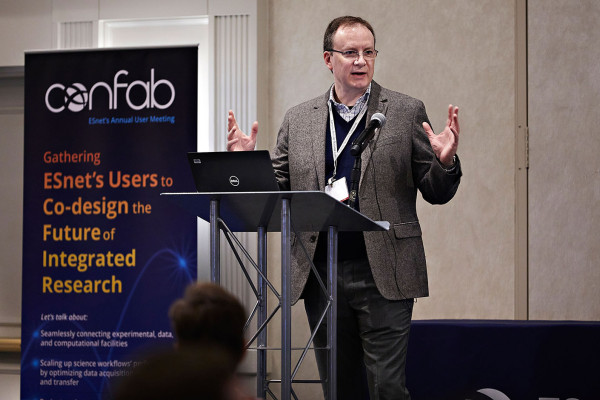
ASCR Facilities Director Ben Brown opens ESnet’s user gathering, Confab, in 2023.
The second Confab, in 2023, focused on an ambitious new initiative from the DOE: the Integrated Research Infrastructure (IRI), which aims to seamlessly integrate scientific facilities, data management, and computing to power scientific discovery. ESnet was the fabric that would connect those key resources. As the 2024 ASCAC Facilities Subcommittee Recommendations report stated plainly, "Without ESnet, the entire vision collapses; none of the facilities, nor the integrated Ecosystem, nor IRI could function.”
Looking Ahead: Wireless, Quantum, and Super Intelligence
Pushed by Monga, ESnet's vision has begun to extend beyond the fiber-optic network. As they begin to plan for ESnet7, the next generation of the network, ESnet staff are exploring new areas. ESnet’s Wireless Edge team works with field scientists to connect sensors in remote areas using private cellular and satellite networking, transporting data for geothermal energy research, atmospheric radiation monitoring, and more.
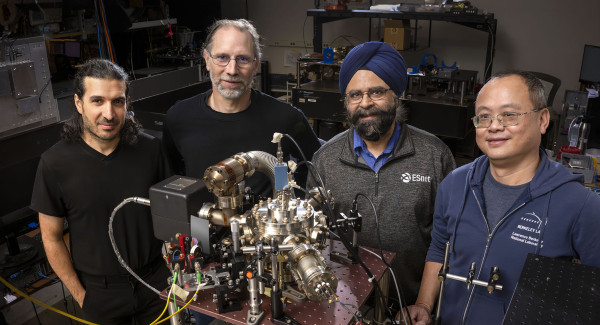
Left to right: QUANT-NET researchers Erhan Saglamyurek, Hartmut Häffner, Inder Monga, and Wenji Wu in 2023 with an early ion trap for a three-node quantum network connecting Häffner’s UC Berkeley physics lab to Lawrence Berkeley National Laboratory.
Quantum networking is another focus. Many quantum networking labs have physicists but not network experts, and thanks to its long history, ESnet staff can see clearly which challenges need to be solved, how automated the systems should be, and how to manage distributed infrastructure across sites. Since 2021, Monga has served also as lead P.I. of the Quantum Application Network Testbed for Novel Entanglement Technology (QUANT-NET) project, and ESnet engineers are building the protocols and hardware needed for distributed quantum computing.
More recently, ESnet staff have been testing Super Intelligence (SI) applications for network operations while exploring the idea of a “self-driving network.” And thanks to its progress on the Integrated Research Infrastructure initiative, it is now serving as the foundation for the American Science Cloud SI-enabled platform for the DOE’s Genesis Mission.
“Throughout our four decades, ESnet has always sought not only to move data quickly and reliably, but also to anticipate, through our co-design efforts, what scientists will need from a network dedicated to them,” says Monga. “Even as we look back proudly on this milestone, we’re focused on what the next decade will bring.”

READ MORE:Brian Tierney on the beginning of SCinet Cees de Laat on innovating with four ESnet directors Share your ESnet story or memory Follow #ESnetTurns40 on LinkedIn |
JOIN US:
Virtual Celebration Wed. Nov. 4, 10 a.m.-1 p.m. Pacific Time: Invited flash talks; a Directors' Roundtable Q&A with Bill Johnston, Steve Cotter, Greg Bell, and Inder Monga; and breakout rooms grouped by ESnet era for informal socializing. See schedule and register here. Celebration at SC26 Mon., Nov. 16, 7:30-9 p.m. Central Time: At the DOE Booth at Supercomputing 2026 in Chicago. No RSVP needed. |