ESnet Turns 40: The Beginning of SCinet
To mark our 40th anniversary of accelerating science, ESnet invited our science users, DOE site engineers, research & education collaborators, current and former staff, and other community members to share stories and insights about ESnet.
Share your memories here via our virtual guestbook.
By Brian Tierney, retired Berkeley Lab/ESnet engineer (and continuing ESnet consultant)
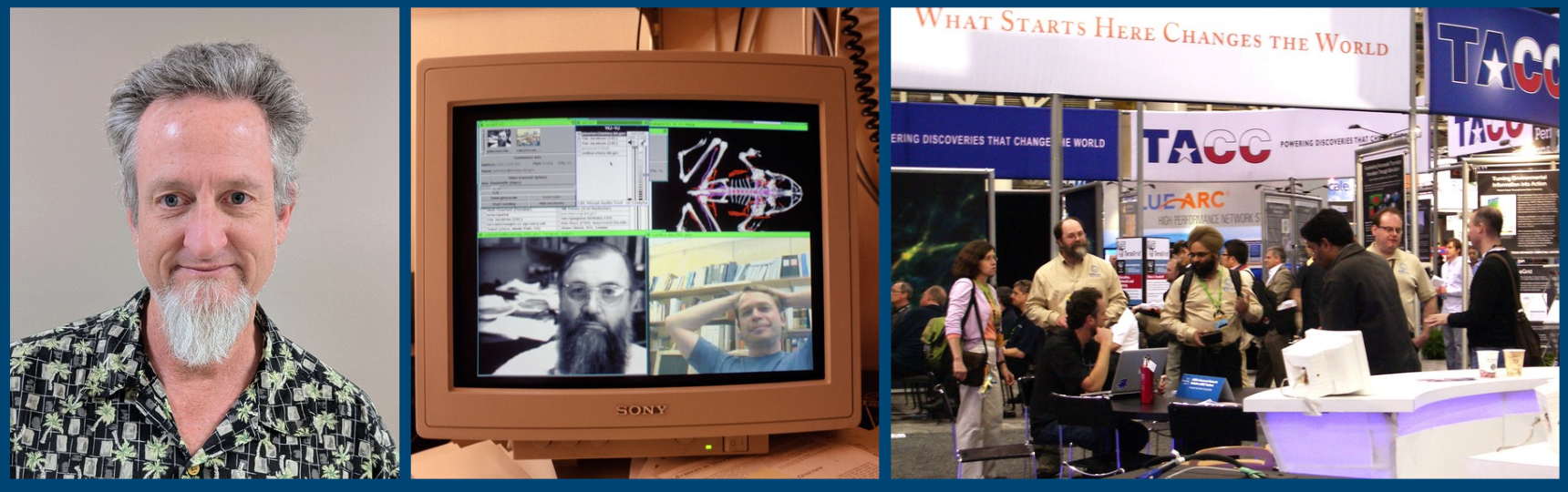
Brian Tierney today: Bill Johnston and Van Jacobson in 1996, demonstrating early videoconferencing tools at Berkeley Lab, and Tierney (seated at table, left) at Berkeley Lab's booth at Super Computing conference in 2011, with ESnet employees Joe Metzger (standing, left) and Inder Monga (center, now executive director)
At Supercomputing ’91 in Albuquerque, Berkeley Lab’s presence was modest: the LBL “booth” consisted of a single card table and two chairs. But some important networking history was being made there. SC91 marked the first year of SCinet, the conference’s high-performance network, and LBL researchers Bill Johnston and I were there to help Van Jacobson demonstrate high-speed wide-area distributed computing between Albuquerque and the Pittsburgh Supercomputing Center.
Jacobson was already one of the seminal figures of the early Internet. His pioneering work on TCP congestion control in the late 1980s helped solve the congestion-collapse problems threatening the growing Internet and established algorithms that remain fundamental to TCP. At SC91, Jacobson, with help from Johnston and me, and Cray’s Dave Borman modified and tested the TCP implementations on a Sun workstation and a Cray right up until the exhibits opened. Van reportedly worked on the Sun for nearly 48 hours straight to get the two TCP stacks to interoperate.
option, allowing the connection to reach roughly 15 Mb/s—compared with less than 2 Mb/s using TCP’s standard 64-Kbyte window. This work helped lead to RFC 1323, published the following year, which standardized TCP window scaling and other extensions needed for high-bandwidth, long-distance networks. Together with Jacobson’s earlier congestion-control work, these innovations were key to TCP’s success and its ability to scale from the early Internet to today’s high-speed global networks.
ESnet began participating formally in SCinet as an organization several years later, and has been a major part of it ever since: ESnet's Dylan Jacob will lead the team of 200-plus volunteers as SCinet Chair for 2026.

READ MORE:Feature story: "Four Decades of Accelerating Science: ESnet Turns 40" Cees de Laat on Innovating with Four ESnet Directors Share your ESnet story or memory Follow #ESnetTurns40 on LinkedIn |
JOIN US:
Virtual Celebration Wed. Nov. 4, 10 a.m.-1 p.m. Pacific Time: Invited flash talks; a Directors' Roundtable Q&A with Bill Johnston, Steve Cotter, Greg Bell, and Inder Monga; and breakout rooms grouped by ESnet era for informal socializing. See schedule and register here. Celebration at SC26 Mon., Nov. 16, 7:30-9 p.m. Central Time: At the DOE Booth at Supercomputing 2026 in Chicago. No RSVP needed. |