

Long Exposure: Paul Porter's Organic Career Path
Bonnie Powell, bpowell@es.net
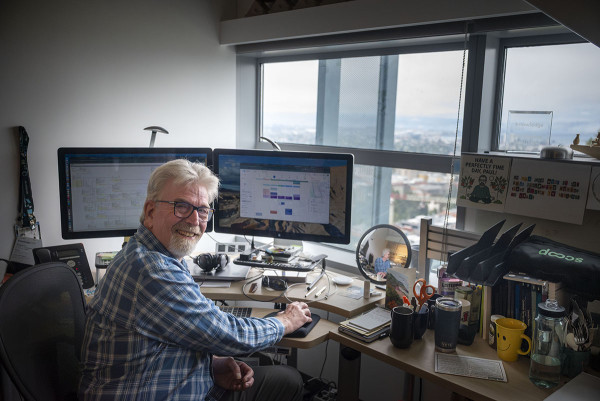
Paul Porter at his desk in Shyh Wang Hall at Berkeley Lab, overlooking Berkeley and the San Francisco Bay.
Some people’s careers look like a straight line running from college to retirement; others seemingly detour to take in different views. For Paul Porter, who’s retiring at age 69 after 13 years as ESnet's ServiceNow administrator, the path has looked more like the trails he enjoys hiking around the Bay Area and High Sierra.
Paul’s first real job was as a Cold War intelligence operative in the Air Force, followed by running production at a “Buddhist bakery” for organic, whole-grain bread. He then studied mechanical engineering because he dreamed of being a part of the large-scale effort of building orbital solar power farms that would beam energy down from geosynchronous orbit. The farms never got built — such research is only now progressing — but this path that seemed to wander was, in fact, going somewhere.
"All along, I was learning how to leverage problem-solving techniques by understanding and observing relationships between objects, processes, and concepts, in order to reach and sometimes exceed desired outcomes," Porter explains.
That sensibility — patient observation, understanding how things and people connect, solving problems by studying relationships rather than just applying rules — would prove remarkably transferable. After engineering school, Porter switched gears completely and worked in the outdoor equipment industry, eventually landing at The North Face (back when it still had a manufacturing facility in Berkeley), where he handled pre-production engineering and building bills of materials for parkas, tents, and sleeping bags. He moved to Sierra Designs where he managed reporting of raw materials and finished goods inventory, then to a small IT consultancy called DataFlex, then to CNET, where he spent roughly 12 years and grew into a desktop support manager who enjoyed working with people at all skill levels. He survived the 2008 recession by running his own small-business IT consultancy, then took a position as IT Support Manager at The Trust for Public Land.
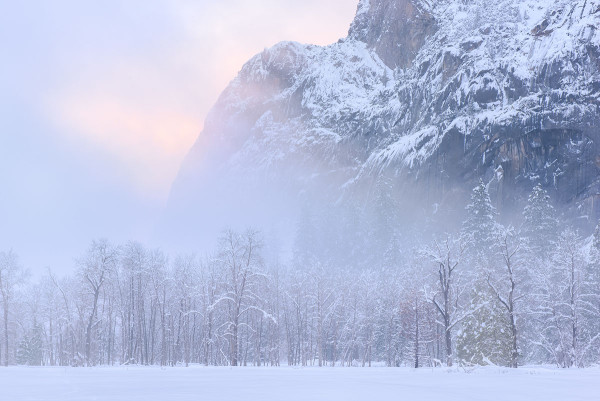
"Pastel Sunset in Yosemite Valley": Photo by Paul Porter
After he was laid off, a colleague forwarded him a job posting from ESnet. "I recall reading the req and immediately feeling a strong affinity for the position," Porter says. "It was another door opening, which turned out to be very rewarding."
Back in 2013, ServiceNow was a relatively new software platform, not the enterprise behemoth it is today. Recalls ESnet Data and Facilities Group Lead Anne White, who interviewed Paul for the role and was on the same team for several years, "There wasn't a lot of ServiceNow-specific knowledge out there, except for a small handful of people, one of which had just left. We needed someone who wasn't necessarily a ServiceNow expert, but who was a process expert. And lucky for us, Paul needed a job."
Porter would go on to become one of the architects of ESnet's ServiceNow environment, but he is careful to distinguish between the technical act of implementation and the work that actually matters. "Implementing ServiceNow at its core is simply a technical exercise of bringing a set of process-enabling tools into the environment," he said. "Sculpting those tools for efficacy in the ESnet environment is what's most important."
That sculpting involved close collaboration across the organization, from Operations and Network Engineering to Business Administration, and over 13 years, it has accumulated into a platform that touches nearly every corner of how ESnet runs. Porter is most proud of a ServiceNow project he worked on from 2020 to 2021 — a large, multi-team effort to improve ESnet's processes for Incident Management, Change Management, and Configuration Management. The scaffolding built during that project has supported years of subsequent improvements and made possible a number of operational enhancements, including a customer service portal where external ESnet users can log in to see the performance and uptime of the services they rely on. "It was really gratifying to be part of the team to build that foundation and to see that even after all that time, it still has legs," says Porter.
He also spent roughly a year building out the staff onboarding process with Business Administration stakeholders — a workflow that has continued to evolve and remains in active use — and built the PurchaseNow process, which after about 10 years, is just now being revisited. When Porter arrived, White recalls, purchasing at ESnet was handled through two email lists — “low val” and “high val,” for the size of the transaction. The system Porter built, PurchaseNow, replaced that primitive arrangement with a scalable process better suited to a growing organization. And he significantly expanded the Service Catalog, the grid of request types that ESnet staff rely on daily.
"Business processes are not popular," White observes. "People will complain when it's not what they want, but they will not praise people when it is what they want. The baseline tends to be, ‘Everything should work the way I think.’ And Paul, to his credit, keeps driving forward anyway, because it's clear this is a passion of his."
For Porter, the proudest part of his 13 years at ESnet is harder to capture in a project list. "Building relationships, collaborating, and just sharing in the journey of solving problems and delivering solutions have been tremendously rewarding," he says. The ESnet community of "astoundingly driven, intelligent and thoughtful people" is what he expects to miss most.
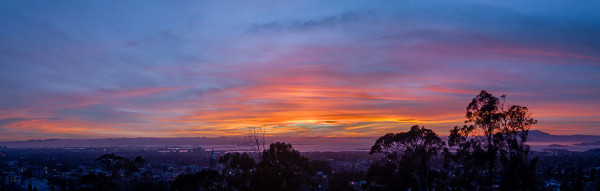
"Brewlette Sunset" by Paul Porter, iPhone panorama shot from Building 59 at Berkeley Lab.
He will also miss the incredible, 180-degree view of the San Francisco Bay from his desk at Shyh Wang Hall at Berkeley Lab. Porter has been a working photographer for decades — starting with interpreting aerial photography for the Air Force — and he sees the same skills threading through both pursuits: patience, observation, technical aptitude, a willingness to push through perceived barriers. He describes himself as a "visual opportunist" who focuses primarily on landscape and nature photography, though he has been shifting toward more contemplative, intimate, and abstract compositions in recent years. Even though it’s not his “focus area,” he’s also taken many of ESnet’s group photos over the years.
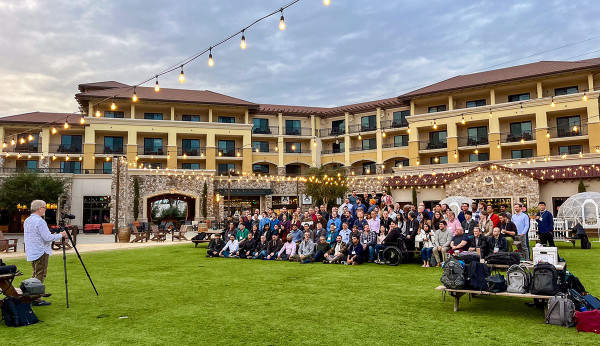
Porter taking an ESnet group shot during the January 2024 all-staff retreat.
In retirement, he plans to offer beginner photography workshops — something that will combine his teaching impulse and the technical eye he has been developing across a lifetime. The rest of retirement looks like this: more time with his wife (Marina), more cycling, hiking, backpacking, cooking, and learning, and possibly some volunteering.
Asked for a piece of parting advice to someone just joining ESnet, he laughs — “ONE piece?” — and offers a collection instead: Be patient, observe, be willing to learn from everyone, respect the organizational culture but be willing to challenge it, seek consensus but expect leadership to lead, ask questions, communicate clearly, and above all, make yourself a valuable member of the ESnet organization. "Independent problem solving may seem more efficient sometimes and may appear to be the right choice, but collaborative problem solving is almost always more effective,” he says. “You work on a team, so make yourself a valuable teammate."
ESnet Deputy of Business Operations Susan Lucas, who has worked with Porter on many projects over his decade-plus tenure, says that Porter himself has walked his talk on that last piece of advice. "Whether ESnet has realized it or not, Paul’s work has touched everyone — from onboarding new staff and helping them find their footing at ESnet, to keeping ServiceNow upgrades moving forward smoothly, on time, and with minimal disruption,” she says. “In many ways, his work has been a lot like the network itself: essential, reliable, and often invisible when everything is working exactly as it should.”
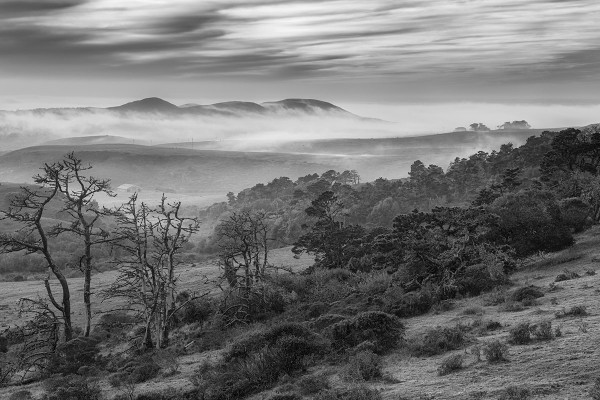
"Point Reyes Ranchlands at Dusk," by Paul Porter
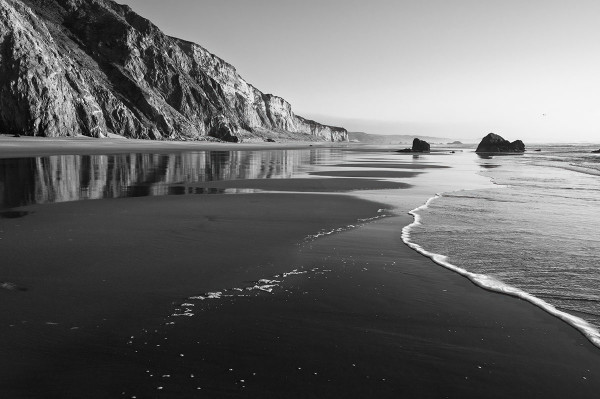
"Kehoe Beach Sunset," by Paul Porter

