

QUANT-NET Control Plane Software Provides an Open-Source Toolkit for Quantum Testbed Researchers
The QNCP software provides a starting framework that researchers can adapt to operate their multi-node quantum testbeds
By Sara Harmon, media@es.net
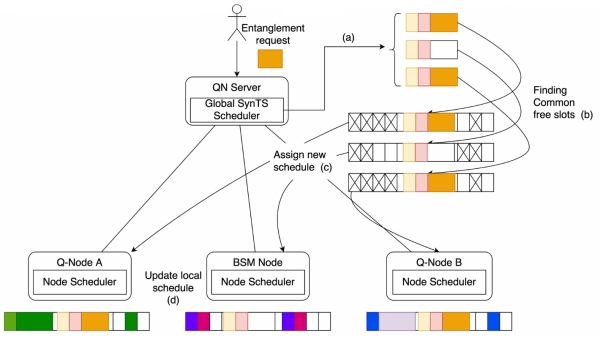
Overview of how the QNCP Software works (Image Credit: Se-young Yu)
Key Takeaways:
- The first open-source, general-purpose quantum network orchestration toolkit has been released by the Quantum Application Network Testbed for Novel Entanglement Technology (QUANT-NET) research project at Lawrence Berkeley National Laboratory.
- The QUANT-NET Control Plane (QNCP) assists researchers in two ways: operating an existing physical quantum testbed, and developing and testing new tools in a sandbox environment.
- The QNCP was designed to shorten the time it takes to get a new quantum network testbed up and running.
The Quantum Application Network Testbed for Novel Entanglement Technology (QUANT-NET) at Lawrence Berkeley National Laboratory (Berkeley Lab) has released an open-source, general-purpose quantum network orchestration toolkit, the QUANT-NET Control Plane (QNCP), for research teams operating quantum networking testbeds. The first network-wide testbed operating system, the QNCP provides a starting framework that researchers and practitioners can use to easily operate their multi-node quantum testbeds. The modular software design’s common components, including scheduling algorithms, resource representations, and hardware abstractions, are designed to allow it to manage a wide variety of testbed designs and technologies.
Quantum networking, a rapidly advancing field that aims to enable many new applications, including scalable and distributed quantum computing, often relies on transmitting quantum information using single photons. Where classical networking transfers data via a system of 0s and 1s, quantum networking leverages fundamentally different physical principles, encoding information as quantum states in qubits, which are in superposition and may be entangled with one another. Classical networking works reliably for the tasks we ask of it, delivering the emails, websites, and movies demanded by billions of users as well as transferring large datasets for scientific research and industry experts. Rather than replacing classical infrastructure, quantum networking will add a specialized capability for tasks where increased privacy, precise measurement, or large-scale, coordinated quantum computing power is required.
The QUANT-NET project has been funded since 2021 by the U.S. Department of Energy’s (DOE) Office of Science Advanced Scientific Computing Research (ASCR) program and is led by dual-appointment researchers at Berkeley Lab, UC Berkeley, and the Energy Sciences Network (ESnet), working with partners from the California Institute of Technology and the University of Innsbruck. The QUANT-NET project’s goals are closely aligned with the recent Executive Order on Ushering In The Next Frontier Of Quantum Innovation, which charges the Secretary of Energy to develop a plan for using quantum networking to enable distributed quantum computing for research purposes. This order complements the priorities established at the July 2023 DOE ASCR Workshop on Basic Research Needs in Quantum Computing and Networking that are outlined in the related report: developing “end-to-end software toolchains to program and control quantum systems and networks at scale” and “hardware and protocols for next-generation quantum networks.”
QNCP Capabilities
The QUANT-NET team is building a three-node distributed testbed connecting Berkeley Lab and UC Berkeley to study entanglement distribution between quantum computing nodes. The goal is an autonomous, or self-managing, testbed that can exchange quantum information over dedicated fiber, demonstrating the fundamental capabilities needed for at-scale distributed quantum computing.
While the QUANT-NET project focuses on building on the core physics and hardware necessary for quantum communication, an important goal of the project is building a complex software layer to coordinate and manage the distributed components. The QUANT-NET Control Plane (QNCP) was designed to handle the immediate orchestration, control, and scheduling needs of QUANT-NET’s testbed. The platform is built to work in conjunction with the open-source device-level control system ARTIQ, which was initially developed by M-Labs in collaboration with the Ion Storage Group at NIST.
Prior to developing the Control Plane, the QUANT-NET experiments were largely conducted through local scripts that required researcher intervention to coordinate. If a component needed to be calibrated or the timing of nodes at different locations had to be synchronized, someone on the team often had to launch a program. If two experimental nodes are located next to each other in the lab, this is a time consuming but manageable task. However, QUANT-NET’s goal is to operate quantum networking with multiple distributed nodes: automated orchestration significantly increases scalability. The QNCP’s centralized orchestration helps manage and automate more complex operations in real time, which is necessary for practical applications.
QNCP provides a number of interfaces and reference implementations for common quantum network orchestration tasks. These include functions such as:
- Resource Discovery and Management: The QNCP keeps track of all available quantum and classical hardware devices on the testbed network and manages their capabilities and how they are configured. New devices can be added via plugin and integrated into the existing system.
- Routing: Determining the specific physical path that quantum information will take across the network’s nodes is a central function of the QNCP. Finding routes across a quantum network topology is crucial for experiment correctness and tasks such as entanglement generation.
- Scheduling: The QNCP uses two tiers of scheduling to manage the network resources, allocating pre-defined time slots to each network function:
- At the network level, the scheduler assigns the time slots and precisely syncs the operations of the individual network functions.
- Each node also has its own scheduler that drives and configures the hardware.
- Monitoring: Continuously tracking the health, performance, and status of network components is critical for keeping the experiments on the right trajectory and enables researchers to catch performance issues early. The monitoring system also ensures that equipment is automatically calibrated at regular intervals.
A Tool for Any Quantum Testbed
Other testbeds can also make use of the QNCP modular plugin architecture because it is designed to be highly adaptable to various experimental configurations. “Software solutions for these common tasks would ordinarily need to be designed and implemented from scratch,” notes Ezra Kissel, ESnet Pilots & Prototypes network engineer and QNCP’s lead software developer. “With QNCP, any quantum network testbed that operates in a distributed manner can build upon the provided plugins or extend them to suit their particular needs.”
For research teams without software engineering and UX expertise, the QNCP reduces the need to program bespoke solutions for every component. While research teams must still develop drivers for their specific hardware, simple components can be integrated rapidly. Once integrated, the QNCP’s standardized plugins minimize manual orchestration time and reduce potential errors. Much like a modern operating system abstracts complex hardware management for a computer user, the QNCP provides a uniform environment.
The software could lead to increased collaboration among testbeds. “For our project, the QNCP is a foundational piece of technology,” said Inder Monga, lead PI of the QUANT-NET project and Executive Director of Energy Sciences Network. “We also hope that sharing the QNCP will accelerate development and operation of quantum networking testbeds in the community, moving the discussion to standards and interoperability that will lead to the era of Distributed Quantum Computing and Quantum Data Centers.”

